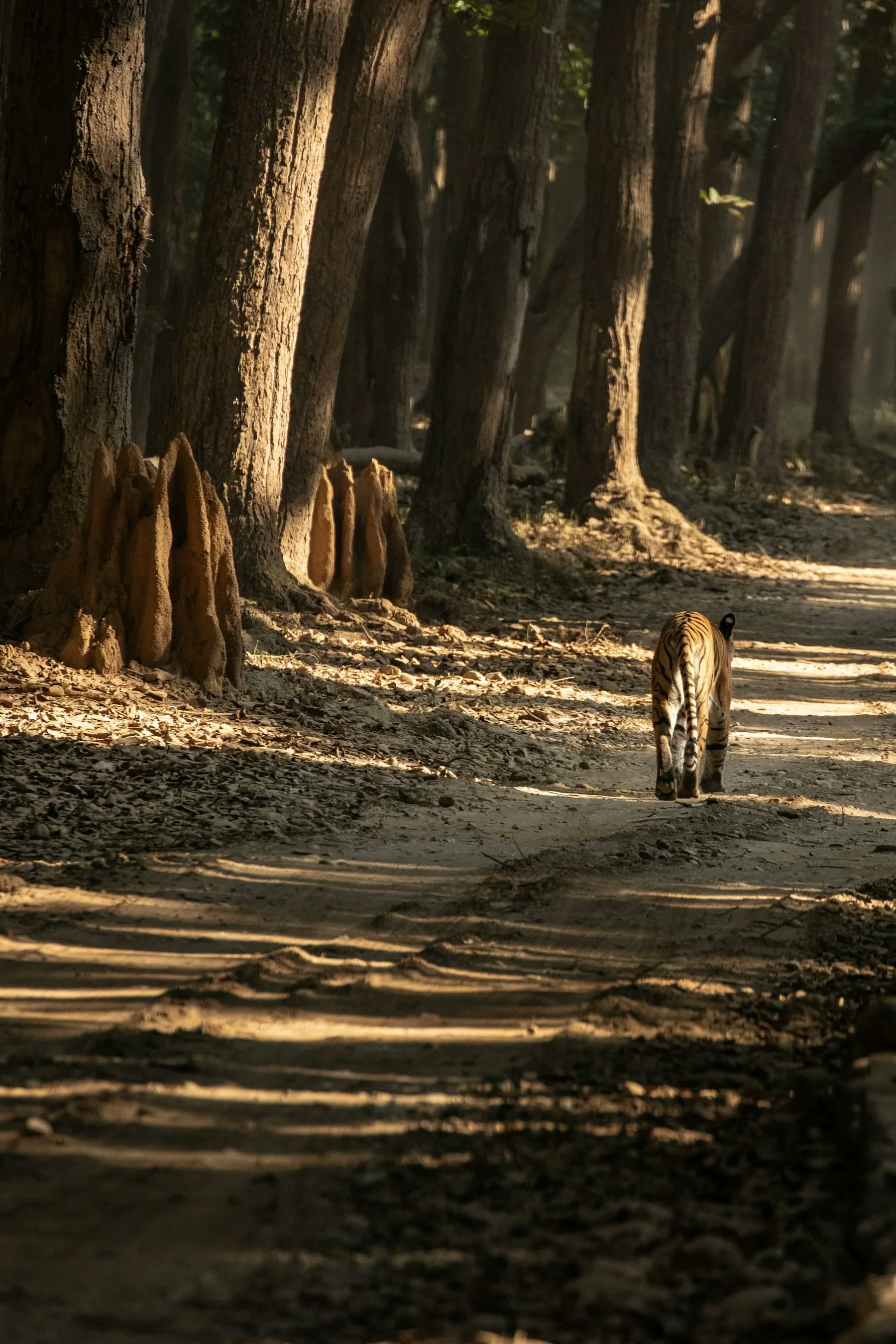
Choosing between Rajaji and Sariska is really choosing between two regions: the Shivalik foothills of Uttarakhand, reached from Haridwar and Rishikesh, and the Aravalli hills of Rajasthan's Alwar district, from Delhi and Jaipur. Both are official tiger reserves with their own booking systems, gates and published rules. This page sets the two official records side by side and stops there — no verdicts, no counts, and no figure the sources do not print.
Sources checked on 8 November 2026: the NTCA's tiger reserves list and its Sariska brief note; Rajasthan Tourism's Sariska page and its Alwar page; the Rajasthan Forest Department's safari and zoo ticket booking page; and the reserve's own Chilla page and booking page.
Location and landscape
Rajaji lies in Uttarakhand, across the Dehradun, Haridwar and Pauri Garhwal districts, in the Shivalik foothills along the Ganga's riverine belt — sal forest, grassland and river edges. Sariska lies in Rajasthan's Alwar district, in the Aravalli hills, and Rajasthan Tourism describes its terrain as mountains, grasslands, dry deciduous forest and cliffs over more than 800 square kilometres. The NTCA brief adds that its vegetation is northern tropical dry deciduous forest in the world's oldest mountain range.
The practical difference is the scenery on the way to the gate and inside it: a Shivalik and riverine landscape on one side, a dry Aravalli landscape.
Size and protected-area history
Each record is quoted from its publisher. Rajaji: national park notified in 1983, spread over 820.42 sq km, and in 2015 a further 255.63 sq km of adjacent reserve forest was added as buffer, taking the declared tiger reserve to 1,075 sq km. Sariska: a sanctuary in 1955 and a national park in 1979 per Rajasthan Tourism's Alwar material, and a tiger reserve in 2007 per the NTCA table.
On area the official sources disagree, which this page reports rather than resolving. The NTCA brief note gives a core of 881.11 sq km, a buffer of 322.23 and a total of 1,203.34 sq km; the NTCA's own reserves table prints the same core but a buffer of 332.23 and a total of 1,213.34. Two figures from one authority: treat the areas as varying by official source and check which document you are quoting.
Gates
The gate question is where the two trips start to diverge. Rajaji publishes six day-visit zones — Chilla, Chillawali, Chaurasi Kutiya, Haridwar, Motichur and Ramgarh — each entered through its own gate, and the booking page's zones are the ones the calendar offers. Sariska is named with two gates only, Sariska Gate and Tehla Gate, in the Rajasthan Forest Department's booking system. Fewer named gates means a smaller choice, not none: you still pick the entry point your booking names and report there.
Season and the weekly closure
Rajaji's season is published inconsistently: the banner and most zone pages say 15 November to 15 June, while the booking page's own Chilla line says 15 October to 15 June. On 8 November 2026 the calendar's first open day was 15 November, and the calendar is the authority for your date.
Sariska's record differs in kind. Rajasthan Tourism's Alwar material states that entry to the forest is closed on Wednesdays — the only opening rule this page could verify officially. No official season table or shift timetable for Sariska was confirmed, so none is printed here, and no official monsoon closure is claimed. Check the live calendar of Rajasthan's official booking route instead of borrowing Rajaji's season.
Booking and identity
Rajaji is booked on the reserve's own portal: date, zone, shift, visitor details with the group leader, payment, day-visit ticket, print the permit. The guest-login page makes a passport mandatory as identity proof for non-Indians and states that online booking can be done only with a static IP, preferably a desktop PC. Sariska is booked through Rajasthan's official booking route, reached via the Rajasthan Forest Department's safari and zoo ticket booking page and a Rajasthan single sign-on — a route the NTCA lists for Sariska on its tiger reserves page.
Two cautions keep this honest. No official Sariska passport rule was confirmed, so Rajaji's passport requirement is not copied across — check what Sariska's own route asks for. The systems are not interchangeable: two reserves, two portals, two sets of identity checks.
Wildlife, without counts
Rajaji's own pages describe elephants, tigers, leopards and deer, and the Chilla page puts the park at approx. 315 bird species. Sariska's distinction is historical rather than numeric: the NTCA brief records wild tigers from Ranthambhore translocated to repopulate it after local extinction, beginning in 2008 — an effort the brief calls the first of its kind in the world, on a recovery plan with the NTCA and the Wildlife Institute of India.
Neither side is a count, and this page states no tiger population figure for either park. A permit buys an entry, not an encounter, in both reserves.
Access and distances
Only published figures are used, each attributed to its page. For Rajaji: Delhi to Chilla about 224 km via NH 334, Dehradun about 55 km, Jolly Grant about 40 km, from the reserve's own pages. For Sariska: Rajasthan Tourism's Alwar material puts it about 200 km from Delhi and about 107 km from Jaipur. Those four numbers come from two authorities and end at two different gates: they are reported as published distances, never converted into a drive time or a claim about which road is quicker.
The travel question is geography: Sariska is the Alwar and Aravalli option for Delhi and Jaipur travellers, Rajaji the Uttarakhand and Shivalik option for Haridwar and Rishikesh. Compare live routes for your dates rather than a figure on any page.
Who each park suits
Rajaji suits a trip anchored in Uttarakhand — Haridwar, Rishikesh or Dehradun — with six zones, a riverine landscape, and an extension beside the Golden Triangle or the north. Sariska suits a Rajasthan itinerary built around Alwar and Jaipur, with two named gates, a dry Aravalli landscape, and the reintroduction history in its brief. Families, photographers and first-timers appear on both lists; what decides it is your starting point, your dates and which calendar offers your day.
The comparison pages on this site go deeper on the neighbours: Rajaji versus Jim Corbett for the closest pair, and Rajaji versus other Indian tiger reserves for the wider field.
What to confirm before you decide
- Which live calendar offers your dates — the reserve's own for Rajaji, Rajasthan's official route for Sariska.
- Which gate your booking names, and where you will sleep relative to it.
- Which identity document each system asks of you, checked on its own page rather than carried across from the other park.
- Which published distance you are actually planning against, and from which city.
What this page will not claim
Seven abstentions. No verdict about which reserve is better. No tiger count for either park. No Sariska season table or shift timetable, because none was confirmed, and no official monsoon closure claimed for it. No invented distance or drive time — only the four published figures above, each attributed. No visa or restricted-area claim for either park, and no sighting guarantee behind any permit.
Where to read next
For the Rajaji side of the decision, the official portal and process guide and the best time to visit guide; for the Delhi approach, the from-Delhi day trip or overnight guide; and for placing a Rajaji leg beside a northern India itinerary, the Golden Triangle extension page. For what a Rajaji day visit actually is before you compare it with anything, the jungle safari overview, and for the portal behind the permit, the booking office and official website page. For direct versus package booking, the packages page; for the Haridwar-Rishikesh drive question, the route page. Sources checked 8 November 2026.
Rajaji versus Sariska: questions answered
Which is closer to Delhi, Rajaji or Sariska?
Both official pages publish a Delhi distance, and they come from different authorities. Rajasthan Tourism puts Sariska about 200 kilometres from Delhi and about 107 kilometres from Jaipur: https://www.tourism.rajasthan.gov.in/content/rajasthan-tourism/en/tourist-destinations/alwar.html. The reserve's own pages put Delhi to Chilla at about 224 kilometres via NH 334: https://rajajitigerreserve.uk.gov.in/chilla-zone.aspx. Those are two distances to two different gates in two different states, published by two different bodies, and neither page publishes a drive time — so this page reports the figures and does not turn them into a journey estimate.
Is Sariska better than Rajaji for tigers?
This page does not rank them and publishes no tiger counts for either. What the official records differ on is history and setting: Sariska was locally extinct and received wild tigers from Ranthambhore beginning in 2008, an effort the NTCA brief calls the first of its kind in the world, on a recovery plan formulated with the NTCA and the Wildlife Institute of India: https://ntca.gov.in/assets/uploads/briefnote/sariska.pdf. Rajaji's own pages describe elephants, tigers, leopards and deer in a Shivalik and riverine landscape. A permit is not a sighting in either park, and neither reserve guarantees one.
When is Sariska open?
Rajasthan Tourism's Alwar material states that entry to the forest is closed on Wednesdays: https://www.tourism.rajasthan.gov.in/content/rajasthan-tourism/en/tourist-destinations/alwar.html. No official season table or shift timetable for Sariska was confirmed for this page, so none is printed here, and this page does not claim a monsoon closure as official. Check the live calendar of Rajasthan's official booking route before you plan. For comparison, Rajaji's season conflict is described in the body of this article: the banner says 15 November to 15 June while the booking page's Chilla line says 15 October, and the live calendar settles it.
Can I combine Rajaji and Sariska in one trip?
Nothing stops you planning both, but they are two protected areas in two states with two separate booking systems, and no combined permit exists. Rajaji is booked on the reserve's own portal with a passport mandatory for non-Indians and a static-IP desktop caveat; Sariska is booked through Rajasthan's official route, whose Forest Department page is here: https://forest.rajasthan.gov.in/content/raj/forest/en/citizen-services/safari-zoo-ticket-booking.html, with the NTCA listing the reserve here: https://ntca.gov.in/tiger-reserves/. This page prints no distance or travel time between the two parks, because none was verified for it.
Which is better for a family?
That is a question about your starting point, your dates and your group rather than about the parks. Delhi and Jaipur travellers are comparing the Alwar and Aravalli option against the Haridwar, Rishikesh and Shivalik option; family logistics turn on the gates, the season and the booking rules each system publishes. Read the two bodies of this article side by side, check the live calendars for your dates, and send any group-specific question through the official contact route for the park you choose. Sources checked 8 November 2026.