The mammals of Rajaji have been listed officially exactly once, in a book published in March 1995 by the Zoological Survey of India. This page reads one chapter of that book — the mammals chapter by N. K. Sinha, running from page 9 to page 23 — and reports what it prints: its author and affiliation, its method, its own order headings, its numbered list, and the boundary it was written against. Every figure below is a 1995 publication figure resting on fieldwork done earlier, and none of them is a count of what lives in the park today.
Sources checked on 4 November 2026: the Zoological Survey of India's own copy of Fauna of Conservation Area 5: Rajaji National Park (March 1995), read as a scanned PDF; and this site's own published pages, linked at the foot of this article.
The chapter, its author and its count
The chapter is titled MAMMALS (MAMMALIA), is signed N. K. Sinha of the Zoological Survey of India, Dehradun, and runs from page 9 to page 23 of the volume. The volume's own summary line records 49 mammals for the park, and the chapter's own numbered list runs from 1 to 49 without a gap — chapter and summary reach the same figure, which is worth stating because the volume does not always provide that agreement.
The chapter is also candid about what kind of document it is. It opens by saying that the national park had recently been established and that a complete list of the fauna present in it should therefore be made. That sentence fixes the chapter's purpose: a first inventory for a newly constituted park, assembled to put names on a list, not a measurement of how many animals there are.
How the list was made: sight records, not captures
The method paragraph is the most important part of the chapter for anyone quoting its numbers. It states that no shooting or trapping permit was issued for the work, and that as a result most of the identification is based on sight records made between 1981 and 1987 during the various faunistic survey tours. A list built from sightings across seven years has a different standing from a list built from specimens in a drawer, and the chapter says plainly which one this is.
Three further details travel with that method, and each of them changes how the 49 should be read:
- The classification follows Simpson (1945) — a mid-century scheme, so the order and family names in the list are the chapter's names rather than current ones.
- Distribution and description follow Ellerman and Morrison-Scott (1951) and Prater (1971) — the chapter's entries describe each species from published works rather than from new measurements taken in the park.
- Two species, Axis porcinus and Cuon alpinus, were not recorded by the author himself — they were carried into the list from Singh's 1979 working plans, which claim records in the park area only till 1964-65. Two entries in the 49 therefore rest on literature rather than on the chapter's own fieldwork.
None of this makes the chapter bad science; it makes it a dated inventory with a stated method, which is exactly how it is used here.
What the list covers: nine orders
The chapter's list is organised under its own order headings, numbered from 1 to 49, and those headings run in this order: insectivores, bats, primates, pangolins, carnivores, elephants, ungulates, hares and rabbits, and rodents — nine orders in all, from the hedgehogs and shrews at the head of the list to the rats and gerbils at its tail. That is the chapter's scope, reported from the headings themselves rather than inferred.
What is deliberately not produced here is a count of species by family. The chapter prints family headings beneath each order, and a reader who adds them up is doing arithmetic the book never did; this page does not transcribe a species list from the scan either, because a list reconstructed by eye puts guesses where the printed names should be. The closing pages of the chapter also carry a short list of carnivorous mammals, reported here only as a feature of the chapter's layout.
The park the chapter describes
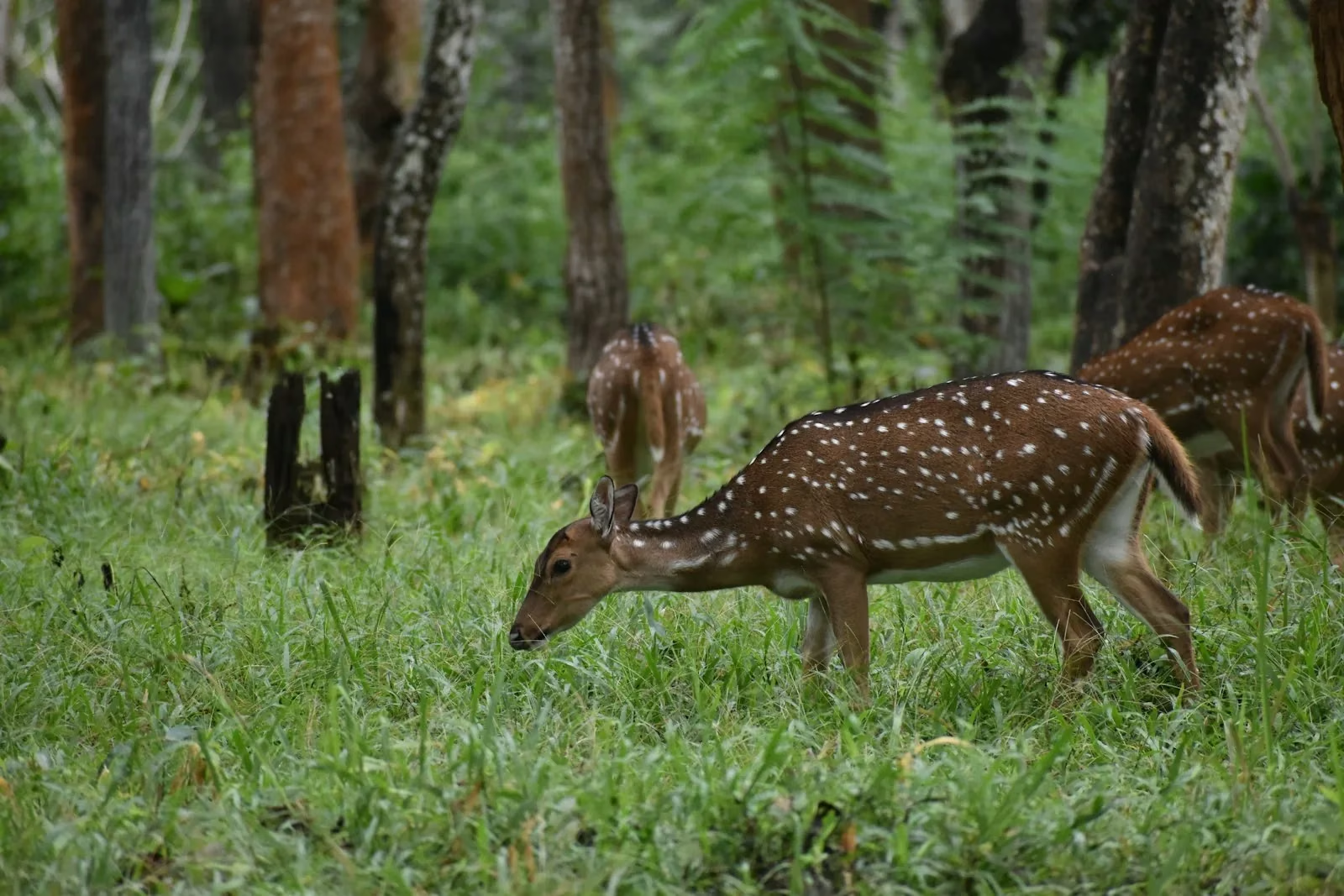
The chapter opens with a short physical description of its subject: the park at the foot hills of the Himalayas on the Siwalik ranges, a bhabhar track of thick boulder deposits with a low water table and relatively drier conditions, and a forest type described as northern tropical dry deciduous, composed of Shivalik sal and mixed forest. It then offers a period characterisation — one of the richest areas for the typical big mammals of northern India — naming the elephant, sambar, barking deer, chital and wild boar as abounding there, with tiger, leopard and wild dog as co-predators and hyaena, jackal and bengal fox as scavengers.
Those are the author's words about the park as he found it in the 1980s, and they are quoted here as a historical description of the book's subject, not as a present-day abundance claim for any species. The chapter also records a period judgement of its own: that a number of species had become restricted in number in recent years, which it attributes to habitat alteration, deforestation, agricultural expansion, grazing, spreading urbanisation and poaching. That sentence is a 1995 author's assessment of his own time. This page reports it as such and does not carry it forward as a current threat status for anything.
The boundary: a 1995 book, an earlier park
Three dates frame every figure on this page. The fieldwork runs from 1981 to 1987. The volume was published in March 1995. The final national park notification followed on 14 September 2013, and the tiger reserve was declared in 2015. The volume's own foreword describes the park as it then stood — the former Rajaji, Motichur and Chilla wildlife sanctuaries, in the State of Uttar Pradesh — so the book's 49 mammals belong to the area as then defined.
Two consequences follow, and both are reasons not to treat 49 as a live figure. "Rajaji" in this 1995 book means the park under its earlier boundary, not the notified area of today. And it does not mean the wider tiger reserve either, because a tiger reserve is a larger legal object than its national park: an inventory of the park is not an inventory of the reserve, and no reserve-wide mammal total is offered here.
What this page will not claim
Four abstentions. There is no current mammal total for Rajaji — none was located as of 4 November 2026, and none is assembled from a 1995 scan. There is no abundance, density or encounter rate for any species, because the chapter records identifications rather than measurements of how many animals there are. There is no threat status: no species here is called endangered, protected, declining or stable on this page, since no current assessment was read for it. And there is no species list transcribed from the pages of the scan, because accuracy matters more than completeness in a list of names.
Where to read next
For the park's fauna in one place, the animals list gathers mammals, birds and reptiles together; the wildlife guide covers what a visitor might encounter; and the habitats and flora guide describes the sal forest, riverine belts and grassland those animals live in. Five companions hold other chapters of the same 1995 volume: the butterfly record, the dragonfly and damselfly record, the fish record, the termites, centipedes, wasps and scorpions record and the reptile and amphibian record. The two companion pages in this release are the 2022 tiger estimate article and the 1995 bird inventory article. Sources checked 4 November 2026.
Rajaji's 1995 ZSI mammal record: questions answered
How many mammals does the 1995 ZSI volume record for Rajaji?
49. The volume's own summary records 49 mammals, and the mammals chapter by N. K. Sinha runs from page 9 to page 23 with its own numbered list reaching 49 under nine order headings: https://zsi.gov.in/public/PDFVolumes/cas/005/index.pdf. That is a March 1995 publication figure from a historical inventory, not a census of the park and not a figure for today.
How did the chapter identify its mammals?
Mostly by sight. The chapter states that no shooting or trapping permit was issued for the work, so most identification is based on sight records made between 1981 and 1987 during faunistic survey tours. The classification follows Simpson (1945), and the distribution and description of the species follow Ellerman and Morrison-Scott (1951) and Prater (1971). Two species, Axis porcinus and Cuon alpinus, were not recorded by the author himself and were taken from Singh's 1979 working-plan records, which claim park-area records only till 1964-65.
Which groups does the chapter cover?
Nine orders, under the chapter's own headings: insectivores, bats, primates, pangolins, carnivores, elephants, ungulates, hares and rabbits, and rodents. The list runs from 1 to 49 across those orders. This page reproduces no species count by family, because a tally made by adding family headings is a reader's arithmetic rather than a figure the chapter prints, and no species list is transcribed from the scan.
Is this a current census of Rajaji's mammals?
No. It is a historical official inventory published in March 1995 on sight records of 1981 to 1987 and older literature, and this page claims no present-day total, no abundance, no density and no threat status for any species. The volume also predates the final national park notification of 14 September 2013 and the tiger reserve declared in 2015, so its 49 describe the park as then defined. The chapter's own period remark about species becoming restricted in number is reported in the article as the author's judgement of his own time, not carried forward as a present-day assessment.
Where can the volume be read, and what covers the rest?
At the Zoological Survey of India itself: https://zsi.gov.in/public/PDFVolumes/cas/005/index.pdf — Fauna of Conservation Area 5: Rajaji National Park, March 1995. Companions on this site hold other chapters of the same book: the butterfly record, the dragonfly and damselfly record, the fish record, the termites, centipedes, wasps and scorpions record and the reptile and amphibian record. For the wider fauna: the animals list, the wildlife guide and the habitats and flora guide. The two companion pages in this release are the 2022 tiger estimate article and the 1995 bird inventory article. Sources checked 4 November 2026.