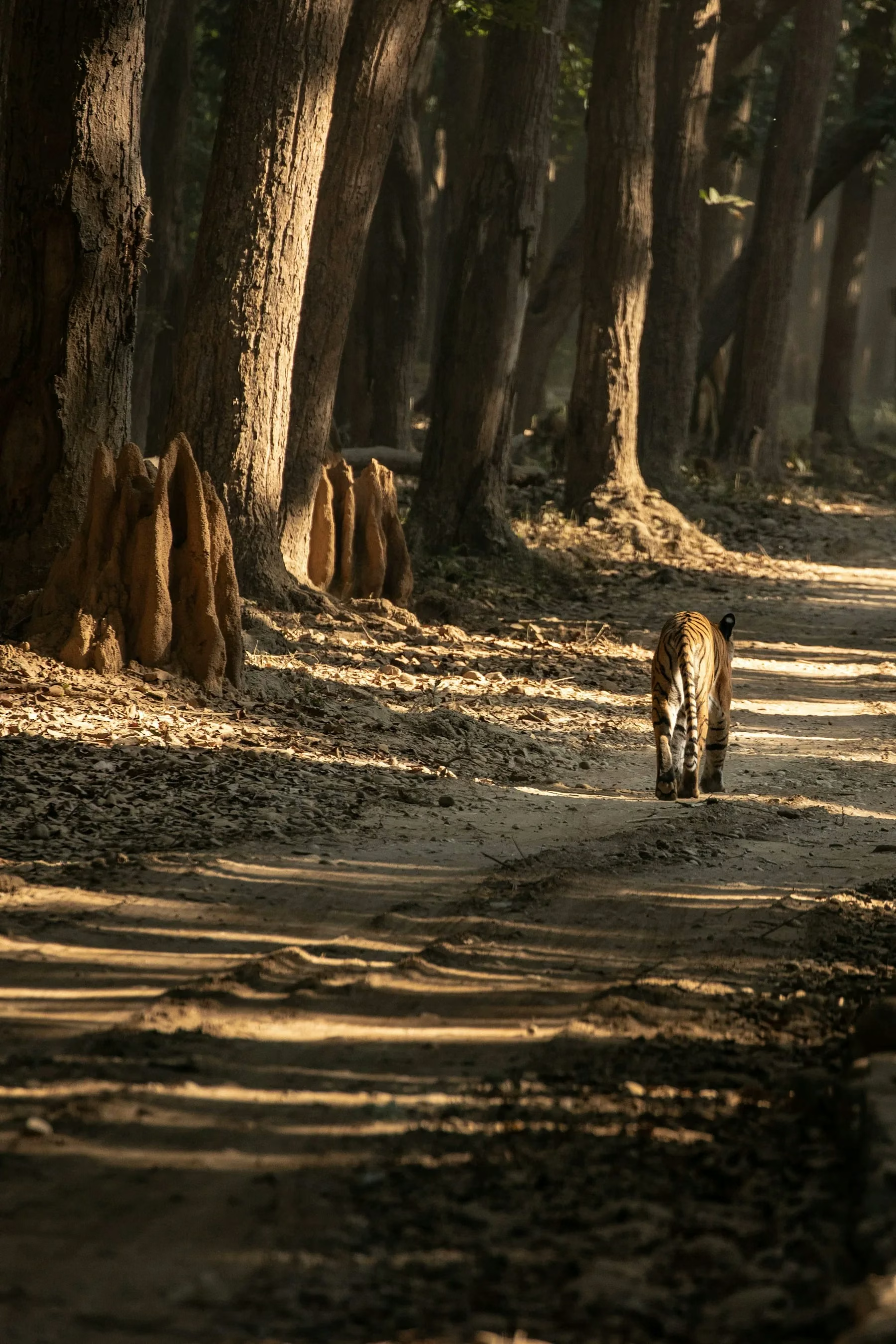
Two reserves in two very different forests: Rajaji in the Shivalik foothills and Ganga riverine belt of Uttarakhand, and Melghat in the Satpura range of Maharashtra, where teak forest fills deep valleys below the Gavilgarh hills. Both are official tiger reserves with their own booking systems and published rules. This page sets the two records side by side and stops there: no verdicts, no counts, and no figure the sources do not print.
Sources checked on 21 November 2026: the Melghat official about page, history page, access page and activities page, the Maharashtra Safari booking portal, the NTCA reserve table and Melghat brief, and Rajaji's own booking page and FAQ; plus this site published guides, linked below.
Location and landscape
Melghat lies on the southern offshoot of the Satpura range in Amravati, Akola and Buldhana districts of Maharashtra, bordering Madhya Pradesh to the north and east. The official site describes the landscape through deep valleys called khoras and high hills called ballas, with the Khandu, Khapra, Sipna, Gadga and Dolar rivers draining the reserve as tributaries of the Tapti. The NTCA brief classifies the forest as Southern Tropical Dry Deciduous, with teak as the dominant species and 769 plant species recorded. Rajaji is the Shivalik and Ganga counterpart, with sal forest, riverine vegetation and the 820.42 sq km national park of 1983.
Size and notification history
Melghat official pages give several area sets, and they are kept apart. The NTCA table gives core 1,500.49 sq km, buffer 1,268.03 sq km and total 2,768.52 sq km. The official about page gives a critical tiger habitat of 1,500.49 sq km, of which 1,150.03 sq km belonged to the initially declared reserve of 22 February 1974, with the Wan, Ambabarwa and Narnala sanctuaries added on 27 December 2007. The history page gives an initial area of 1,571.74 sq km, later expanded to 2,029.04 sq km, and records the wildlife sanctuary of 1967, the tiger reserve of 1974, the Melghat Wildlife Sanctuary of 1985 and the Gugamal National Park of 1987 with 361.28 sq km. The NTCA table records the tiger reserve notification year as 2007. Rajaji history is shorter: the 1983 intent notification merged the Rajaji, Motichur and Chilla sanctuaries, and the 2015 buffer took the reserve to 1,075 sq km.
Tourism centres
Melghat tourism is distributed across four centres in the official wording: Semadoh, Chikhaldara, Harisal and Shahnur, with additional stay facilities at Kolkas, about 14 km ahead of Semadoh. Semadoh is the main centre. Chikhaldara is a hill station and a gateway with private hotels and resorts, and its jungle safari gate is commonly known as Vairat. Harisal is described as a digital village about 25 km from Semadoh towards Indore on Maharashtra State Highway 6. Shahnur is the base for the Narnala sanctuary and its fort. Rajaji zone count is not settled on its own pages: the About text says five, the cards and availability table six, the FAQ four, the booking page six with tariffs and the home page five cards. The full comparison is in the Motichur guide.
Safari, booking and timings
Melghat sells day safari, full-day safari, night machan stay, kayaking, elephant ride, trekking and adventure activities, available at centres including Aamzari, Semadoh, Kolkas, Harisal and Shahnur. The Maharashtra Safari portal lists three Melghat units: Gugamal National Park, Ambabarwa Wildlife Sanctuary and Narnala Wildlife Sanctuary. The official site also links a Maharashtra availability page, but that page returned an error when checked, so the portal is the working booking route. The pages checked do not publish one fixed shift table for Melghat; the portal displays the available slots and the current fees for your date. Rajaji publishes shifts of 6 am to 10 am and 2 pm to 6 pm, with a conducted tour generally two to three hours.
Season and rules
The Melghat official site says tourists can explore in all seasons, with the monsoon from mid-July to the end of September offering the best views, winter nights dropping below 5 degrees Celsius and summer good for animal sightings. It publishes no fixed closure date on the pages checked. Rajaji publishes three season statements that do not agree: 15 November to 15 June on most pages, a Chilla line of 15 October to 15 June on the booking page, and a reversed 15 June to 15 November in the FAQ. On rules, the Melghat site refers visitors to the Wildlife Protection Act 1972, and the Maharashtra Safari portal carries a general notice that mobile phone use and possession are prohibited during safaris in protected areas. The pages checked publish no separate foreign-visitor ID rule, so this page does not borrow Rajaji passport rule for Melghat. Rajaji rules are published: a valid permit and photo ID, a non-transferable permit, approved vehicles only, no private vehicles, mobile phones prohibited inside the safari zones under a Supreme Court order dated 17.11.2025, no flash photography, no food, plastic-free, no smoking or alcohol, staying in the vehicle and no feeding.
Wildlife, without counts
The NTCA brief lists tiger, leopard, jungle cat, hyena, jackal, fox, wild dog, sloth bear, ratel, wild pig, hare, porcupine, mongoose, otter, sambar, chital, gaur, barking deer, nilgai, four-horned antelope, common langur and rhesus macaque, and the official site adds the Forest Owlet. Rajaji material lists elephants, tigers, leopards and deer, with around 315 bird species. Species lists are not population counts, and no sighting is promised by either permit.
Access
Melghat official site publishes route and rail guidance rather than a full kilometre table. Nagpur is the nearest airport, about 250 km away. For Chikhaldara, Semadoh, Kolkas and Harisal, the recommended railhead is Badnera Junction, about 10 km from Amravati on the Mumbai to Nagpur to Kolkata route; for Narnala, it is Akola Junction. Khandwa on the Mumbai to Bhopal route and Betul on the Nagpur to Delhi route are also named as convenient. No official kilometre figure for Semadoh itself was found on the pages checked, so this page prints none. Rajaji Chilla figures are published: Delhi 224 km via NH 334, Jolly Grant 40 km and Dehradun 55 km.
Who each suits
Melghat suits travellers based in Nagpur, Amravati or the Vidarbha circuit who want a teak and Satpura landscape, a choice of Semadoh, Chikhaldara, Harisal, Shahnur or Kolkas, and a reserve that publishes day, full-day and night activities. Rajaji suits travellers based in Dehradun, Haridwar or Rishikesh who want the Shivalik and Ganga setting, the elephant landscape and a zone decision that has to be confirmed against the live calendar. Neither is a better holiday in the abstract; each is a different starting point.
Confirm before you pay
- That the Maharashtra Safari portal lists the Melghat unit and date you want, not a private lookalike site.
- That you know whether you are booking Gugamal, Ambabarwa or Narnala, because they are separate units.
- That you have chosen Semadoh, Chikhaldara, Harisal, Shahnur or Kolkas as your base.
- That you have read the mobile phone and Wildlife Protection Act rules before entering.
- That your access route uses the published rail and airport guidance, not an invented drive time.
Where to read next
The other comparisons in this series are Rajaji versus Sundarbans and Rajaji versus Manas. For the wider set, Rajaji against other Indian tiger reserves, Corbett, Sariska, Dudhwa, Bandhavgarh, Pilibhit, Pench, Kanha, Kaziranga, Satpura, Tadoba-Andhari, Nagarhole, Valmiki, Bandipur, Periyar and Mudumalai. For the Rajaji transaction, the official portal and process guide and the jungle safari guide; for the official charges, the per-zone price guide; for Rajaji zone selection, the safari gates and zone entry guide and which safari zone. Sources checked 21 November 2026.
Rajaji versus Melghat: questions answered
Is Melghat better than Rajaji for tigers?
This page does not rank them and prints no tiger count for either. Melghat lies in the Satpura range of Amravati, Akola and Buldhana districts in Maharashtra, with teak-dominated forest, deep valleys called khoras and the Gavilgarh hills; Rajaji is a Shivalik and Ganga riverine landscape in Uttarakhand. Both publish permits rather than sightings, and a permit buys an entry, not an encounter.
How do I book a Melghat safari?
The reserve's official site links the Maharashtra Safari booking portal, which lists three Melghat units: Gugamal National Park, Ambabarwa Wildlife Sanctuary and Narnala Wildlife Sanctuary. The official site also links a Maharashtra availability page, but that page returned an error when checked. The portal displays the current fees and slots; confirm the unit, date and shift there: https://safaribooking.mahaforest.gov.in/.
When are Rajaji and Melghat open?
Rajaji publishes 15 November to 15 June on most pages while its booking page Chilla line says 15 October to 15 June, so its live calendar decides. The Melghat site says tourists can explore in all seasons, with the monsoon from mid-July to end September offering the best views, winter nights below 5 degrees Celsius and summer good for animal sightings; it publishes no fixed closure date on the pages checked. Confirm the unit and date on the Maharashtra portal: https://safaribooking.mahaforest.gov.in/.
Can I combine Rajaji and Melghat in one trip?
Nothing stops you planning both, but they are reserves in different states with separate booking systems and no combined permit. Rajaji is booked on the reserve's own portal: https://rajajitigerreserve.uk.gov.in/jungle-safari-booking.aspx. Melghat is booked through the Maharashtra Safari portal, with separate units at Gugamal, Ambabarwa and Narnala. This page prints no distance or travel time between the two parks, because no official figure was verified for it.
Which is better for a family?
That is a question about your starting point rather than about the parks. Families in Maharashtra compare the Melghat and Amravati option with the Uttarakhand foothill option; logistics turn on which of the four tourism centres you choose, the activities on offer and which calendar offers your day. Read the two bodies side by side and confirm the identity document each system asks for at booking. Sources checked 21 November 2026.