Two reserves in two very different settings: Rajaji in the Shivalik foothills and Ganga riverine belt of Uttarakhand, and Valmiki in the Himalayan Terai of West Champaran, Bihar, the only tiger reserve in that state. Both are official tiger reserves with their own booking portals, entry points and published rules. This page sets the two records side by side and stops there: no verdicts, no counts, and no figure the sources do not print.
Sources checked on 18 November 2026: the Valmiki official reserve site, its history page, timing page and safari page, the NTCA reserve table and Valmiki brief, and Rajaji's own booking page and FAQ; plus this site published guides, linked below.
Location and landscape
Valmiki lies in West Champaran district, north-west Bihar, in the foothills of the Himalayas. It forms the easternmost limit of the Himalayan Terai forests and is the only tiger reserve in Bihar, in the Gangetic Plains bio-geographic zone, with a combination of bhabar and terai tracts. The terrain is undulating, with a deep water table, boulders and sand deposits; the Gandak, Pandai, Manor, Harha, Masan and Bhapsa rivers flow through it. The vegetation runs from moist mixed deciduous forest to open land, sub-montane semi-evergreen, freshwater swamps, riparian fringes and alluvial grassland, with sal and mixed forest, more than 100 tree and 50 shrub species, low-altitude Chir Pine in the Raghia hills and cane brakes in Madanpur. Rajaji is the Shivalik and Ganga counterpart, with sal forest, riverine vegetation and the 820.42 sq km national park of 1983.
Size and notification history
Valmiki's official pages give three area sets, and they are kept apart. The NTCA table gives core 598.45 sq km, buffer 300.93 sq km and total 899.38 sq km; the reserve history page gives total 898.937 sq km, core 589.789 sq km and buffer 309.143 sq km; the introduction page gives a forest area of 901.07 sq km, a wildlife sanctuary of 880.78 sq km and a national park of 335.64 sq km. The notification chain is long: protected forest in 1953 covering 909.86 sq km, Valmiki Wildlife Sanctuary on 4 May 1978 covering 462 sq km, an expansion of 419 sq km on 6 March 1990 to 880.78 sq km, Valmiki National Park on 5 December 1990 covering 335.64 sq km, and the 1994 constitution as the 18th tiger reserve under Project Tiger. The NTCA table records the tiger reserve notification year as 2012; the reserve history gives 1994. Those are different layers, and neither is merged here. Rajaji history is shorter: the 1983 intent notification merged the Rajaji, Motichur and Chilla sanctuaries, and the 2015 buffer took the reserve to 1,075 sq km.
Entry points
Valmiki tourism runs through three centres, published as Valmikinagar, Gobardhana and Manguraha and described as 40 to 90 km apart. Valmikinagar is the north-western entry, previously Bhainsalotan, on the southern bank of the Gandak at the Triveni confluence of the Narayani, Pachnad and Sonaha, with the Gandak Barrage and the Kouleswar, Jatashankar and Nar Devi temples. Manguraha is the eastern entry, known for grassland and the Lalbhitiya sunset point, with the Bhitiharwa Gandhi Ashram, Rampurwa Ashoka Pillar and Sahodara and Sofa temples nearby. Gobardhana is the middle entry, with deep gorges, small waterfalls, grasslands and the Someshwar peak and Kalika temple. Rajaji zone count is not settled on its own pages: the About text says five, the cards and availability table six, the FAQ four, the booking page six with tariffs and the home page five cards. The full comparison is in the Motichur guide.
Safari and timings
Valmiki publishes a gypsy safari for open vehicles with seating for six adults and a maximum of two hours, available at Valmikinagar, Gobardhana and Manguraha; a canter safari for 12 adults at Valmikinagar; a motor boat and a canopy walk at Valmikinagar; and private vehicle entry at the Bhawanipur check naka at Manguraha. The published jungle safari timing for all zones is 6:00 to 10:00 am and 2:00 to 6:00 pm for online booking, with boating from 9:00 am to 5:30 pm and accommodation check-in at 11:30 am and check-out at 11:00 am the next day. Rajaji publishes shifts of 6 am to 10 am and 2 pm to 6 pm on its booking page, with a conducted tour generally two to three hours.
Season and booking
Valmiki's official home page announces the current safari from 17 October 2026; no closing date was found on the pages checked, so the booking portal is the authority for your date. Rajaji publishes three season statements that do not agree: 15 November to 15 June on most pages, a Chilla line of 15 October to 15 June on the booking page, and a reversed 15 June to 15 November in the FAQ. Valmiki booking runs through the official e-booking portal, with three tourism centres and centre phone numbers published for help; the site advises contacting the centre before or after booking. Rajaji runs a different system: online booking with a static IP and desktop, passport mandatory for non-Indians, a printed permit, approved vehicles only, and mobile phones prohibited inside the safari zones under a Supreme Court order dated 17.11.2025. Valmiki pages checked publish no foreign-visitor ID rule, so this page does not borrow Rajaji passport rule for it.
Wildlife, without counts
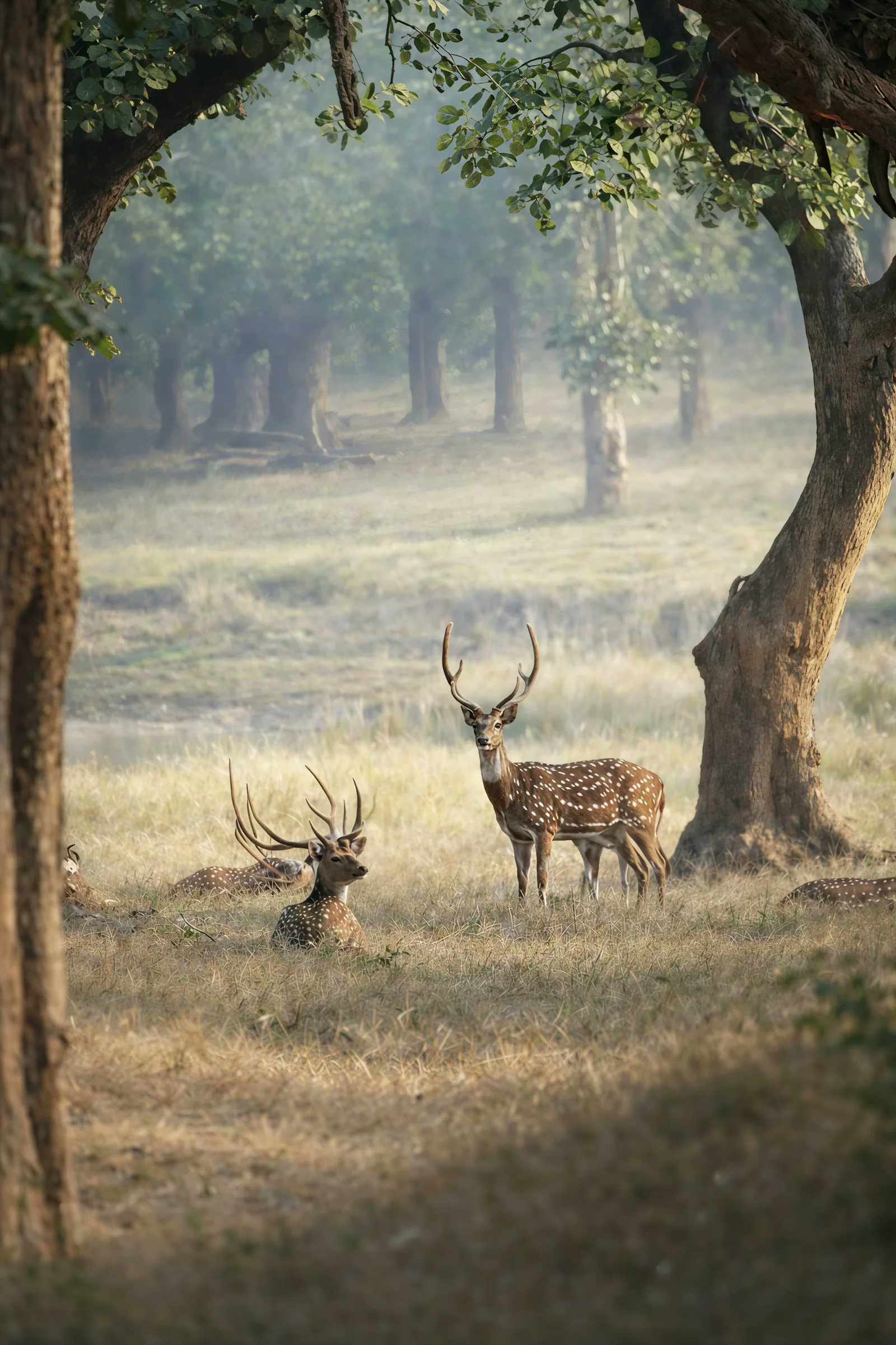
Valmiki's NTCA brief lists tiger, leopard, wild dog, leopard cat and fishing cat among the predators, with spotted deer, sambar, barking deer, hog deer, gaur, nilgai, wild boar, rhesus macaque and common langur, and records 53 mammal species; reptiles include python, crocodile, king cobra, krait, monitor lizard and hill turtle. Rajaji's material lists elephants, tigers, leopards and deer, with around 315 bird species. Species lists are not population counts, and no sighting is promised by either permit.
Access
Valmiki's official zone pages publish road figures. Valmikinagar is about 310 km from Patna, 200 km from Muzaffarpur, 105 km from Bettiah and 125 km from Gorakhpur; Manguraha is about 65 km from Bettiah via Narkatiaganj, with Narkatiaganj about 27 km away. The nearest airports are Patna, Gorakhpur and Kushinagar; the nearest railheads include Narkatiaganj, Bettiah and Bagaha. Rajaji Chilla figures are published: Delhi 224 km via NH 334, Jolly Grant 40 km and Dehradun 55 km. No drive time is published for either set, and none is invented here.
Who each suits
Valmiki suits travellers based in Bihar or the Gorakhpur side who want the Gandak and terai setting, a choice of three entry points and a reserve that publishes its road figures and shift windows. Rajaji suits travellers based in Dehradun, Haridwar or Rishikesh who want the Shivalik and Ganga setting, the elephant landscape and a zone decision that has to be confirmed against the live calendar. Neither is a better holiday in the abstract; each is a different starting point.
Confirm before you pay
- That your date, entry point and shift appear on the official booking portal.
- That you have chosen among Valmikinagar, Gobardhana and Manguraha, which are 40 to 90 km apart.
- That your vehicle is the published gypsy or canter type for that centre.
- That you have confirmed the current season window, since no closing date was found.
- That your access route uses the published road figures, not an invented drive time.
Where to read next
The other comparisons in this series are Rajaji versus Tadoba-Andhari and Rajaji versus Nagarhole. For the wider set, Rajaji against other Indian tiger reserves, Corbett, Sariska, Dudhwa, Bandhavgarh, Pilibhit, Pench, Kanha, Kaziranga and Satpura. For the Rajaji transaction, the official portal and process guide and the jungle safari guide; for the official charges, the per-zone price guide; for Rajaji zone selection, the safari gates and zone entry guide and which safari zone. Sources checked 18 November 2026.
Rajaji versus Valmiki: questions answered
Is Valmiki better than Rajaji for tigers?
This page does not rank them and prints no tiger count for either. Valmiki is the only tiger reserve in Bihar, in West Champaran district, forming the easternmost limit of the Himalayan Terai forests and bordering Nepal and Uttar Pradesh; Rajaji is a Shivalik and Ganga riverine landscape in Uttarakhand. Both publish permits rather than sightings, and a permit buys an entry, not an encounter.
How do I reach Valmiki Tiger Reserve?
The official zone pages publish the road figures: Valmikinagar is about 310 km from Patna, 200 km from Muzaffarpur, 105 km from Bettiah and 125 km from Gorakhpur; Manguraha is about 65 km from Bettiah via Narkatiaganj, with Narkatiaganj about 27 km away. The nearest airports are Patna, Gorakhpur and Kushinagar, and the nearest railheads include Narkatiaganj, Bettiah and Bagaha: https://valmikitigerreserve.com/.
When are Rajaji and Valmiki open?
Rajaji publishes 15 November to 15 June on most pages while its booking page Chilla line says 15 October to 15 June, so its live calendar decides. Valmiki announces its current safari from 17 October 2026 on the official home page, and the published shift windows are 6 am to 10 am and 2 pm to 6 pm; no closing date was found on the pages checked, so confirm your date on the booking portal: https://ebooking.valmikitigerreserve.com/.
Can I combine Rajaji and Valmiki in one trip?
Nothing stops you planning both, but they are reserves in different states with separate booking systems and no combined permit. Rajaji is booked on the reserve's own portal: https://rajajitigerreserve.uk.gov.in/jungle-safari-booking.aspx. Valmiki is booked through its official e-booking portal, with three tourism centres at Valmikinagar, Gobardhana and Manguraha and centre phone numbers published for booking help. This page prints no distance or travel time between the two parks, because no official figure was verified for it.
Which is better for a family?
That is a question about your starting point rather than about the parks. Families in Bihar and the Gorakhpur side compare the Gandak and terai option with the Uttarakhand foothill option; logistics turn on which of the three Valmiki centres you choose, the 40 to 90 km between them, the original ID rule and which calendar offers your day. Read the two bodies side by side and confirm the identity document each system asks for at booking. Sources checked 18 November 2026.