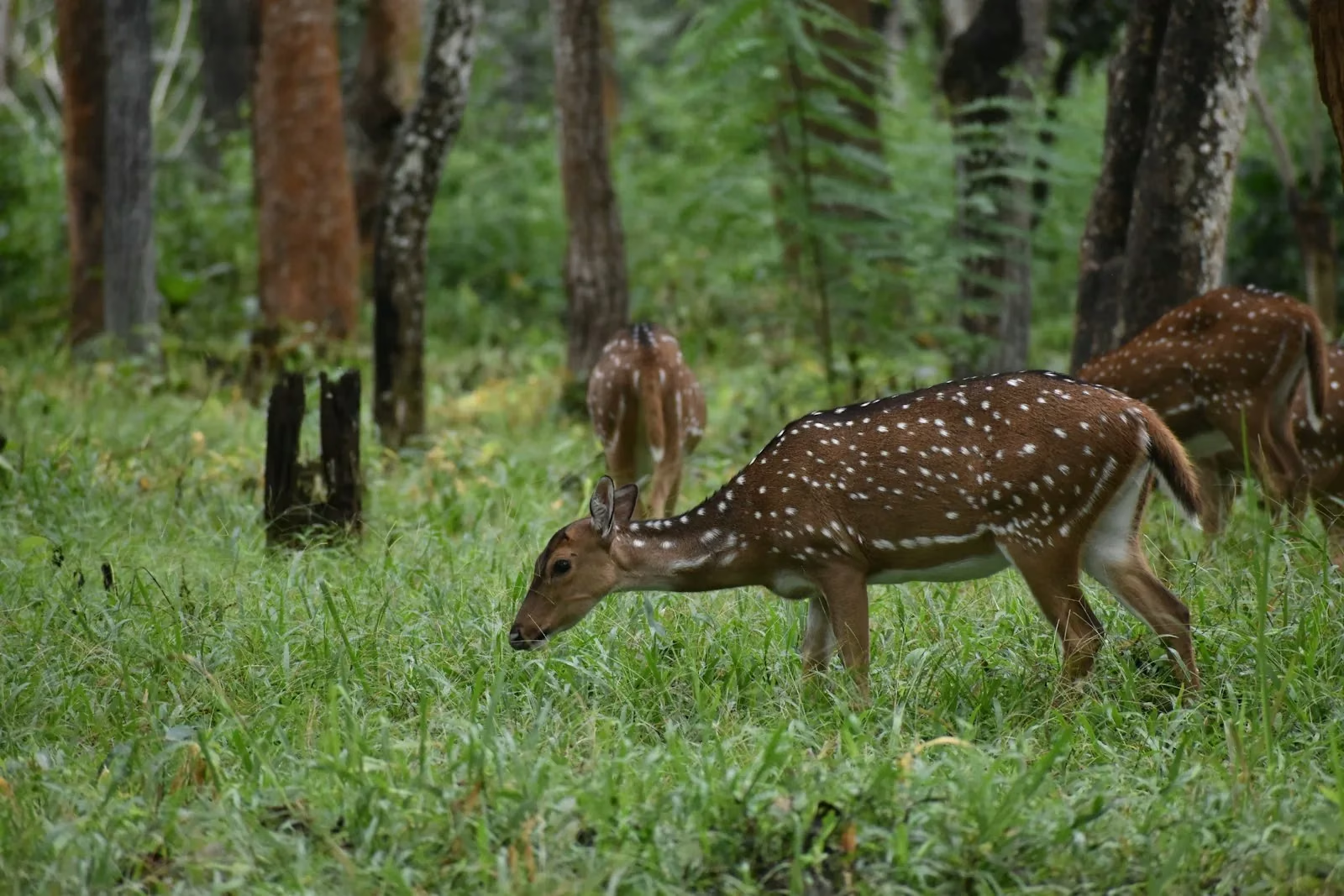
Two tiger reserves, two very different forests: Rajaji in the Shivalik foothills and Ganga riverine belt of Uttarakhand, and Kanha in the Maikal range of the Satpuras in Madhya Pradesh, where sal forest opens onto central maidans. Both are official tiger reserves with their own booking systems, gates and published rules. This page sets the two official records side by side and stops there: no verdicts, no counts, and no figure the sources do not print.
Sources checked on 15 November 2026: the MP Forest Kanha booking page, the NTCA list and briefs, MP Tourism's Kanha material, and the reserve's own Chilla page and booking page; plus this site's own pages, linked below.
Location and landscape
Kanha lies in the Mandla and Balaghat districts of Madhya Pradesh, in the Maikal range of the Satpuras: a sal-dominated forest with central meadows and maidans and Deccan-trap ridges. The official text names two rivers for this landscape — the Banjar and the Halon — and no other river name is invented here. Rajaji is a single-state reserve in the Shivalik foothills along the Ganga's riverine belt, across Dehradun, Haridwar and Pauri Garhwal districts.
The difference is the forest you drive into: sal, maidan and ridge against foothill and riverine belt. Both publish permits rather than promises.
Size and history
Each record is quoted from its publisher, and the figures are not blended. The MP Forest record gives Kanha a core of 917.44 sq km, a buffer of 1,134.361 and a total of 2,051.791 sq km; the NTCA table rounds the same reserve to 917.43, 1,134.36 and 2,051.79. An older NTCA brief carries a different pair — 2,074.31 with a core of 940 — so the current 2,051.79 is used and the older document is not merged into it. Rajaji is a national park notified in 1983 at 820.42 sq km, a tiger reserve in 2015 at 1,075 sq km.
The history runs deeper: a reserve forest in 1879, a wildlife sanctuary in 1933 covering the Hallon and Banjar areas, park status in 1955, Project Tiger's first batch in 1973-74, and the NTCA tiger-reserve notification in 2007.
Zones and gates
Rajaji publishes six day-visit zones — Chilla, Chillawali, Chaurasi Kutiya, Haridwar, Motichur and Ramgarh. Kanha's core comprises Kanha, Kisli, Mukki and Sarhi zones plus the Phen Sanctuary, with a buffer of Khatia, Khapa and Sijhora, and the published entry points are Khatia, Mukki and Sarhi. The portal-wide shift table below describes gate entry and exit windows for the reserve as a whole, so no per-gate shift time is claimed anywhere on this page — the booking flow names the zone or round you actually hold.
Season and shifts, with the wording conflict
The season statements disagree, and each is printed as published. MP Tourism gives the core as open 15 October to 30 June and closed from July to September, the buffer zones as open year-round, and a tourism year of 1 July to 30 June — three statements that do not reduce to one sentence, so each carries its source and no single closure is invented. Rajaji carries its own conflict: 15 November to 15 June against the booking page's Chilla line of 15 October to 15 June, live calendar as the authority.
The MP Forest table, effective for safari dates from 1 October 2026, gives: October to November, 06:00 to 11:30 and 15:00 to 18:00; December to January, 06:20 to 11:30 and 15:00 to 18:00; February to March, 06:10 to 11:30 and 15:00 to 18:30; April to June, 05:30 to 11:00 and 15:30 to 19:00. Those are gate entry and exit windows for the portal as a whole, not slot times for any gate — confirm the table at booking.
Booking and identity
Kanha is booked on the MP Forest portal's Kanha page: full vehicle or single seat, then date and zone or round, with the window opening on the 120th day at 11:00. A guide is compulsory, and vehicle and guide charges are paid at the gate — no prices are printed from it. Inside the protected area mobile phone use is prohibited, Wednesdays are a half-day off, and cancellation runs until 5 PM the previous day.
On identity, no published Kanha passport rule was found, so Rajaji's is not copied across: check what the booking form asks. Rajaji states its own rules plainly — passport mandatory for non-Indians, the static-IP desktop caveat, a printed permit, and the 20-minute gate rule with its late-arrival, no-refund sentence.
Wildlife, without counts
Kanha's official material lists the hard-ground barasingha — described in the reserve's own text as the state animal and the last surviving population of that form — alongside tiger, leopard, dhole, sloth bear, gaur and Indian python. Rajaji's pages describe elephants, tigers, leopards and deer, with approx. 315 bird species on the Chilla page. Neither side of that comparison is a population figure: this page states no tiger, rhino or barasingha count for either park, and a permit buys an entry, not an encounter.
Access, gate by gate
The MP Forest gate table publishes distances with no times attached: Khatia — Jabalpur 160 km, Nagpur 220, Raipur 250; Mukki — 200, 260 and 210; Sarhi — 150 from Jabalpur and 220 from Raipur; Ghurri barrier — 181, 278 and 213. MP Tourism publishes a different set for the same park — Jabalpur 160, Raipur 220, Nagpur 280 — so figures are attributed to their source and left apart rather than averaged. No Delhi distance is published for Kanha, and none is invented. For Rajaji the reserve publishes Delhi to Chilla about 224 km via NH 334, Dehradun 55 km and Jolly Grant 40 km.
Who each park suits
Rajaji suits a trip anchored in Uttarakhand — Haridwar, Rishikesh or Dehradun — with six zones, a riverine landscape and an extension beside a northern itinerary. Kanha suits a Central India itinerary built on Jabalpur or Nagpur, with three entry points, deep forest and a maidan landscape. Families, photographers and first-timers appear on both lists; what decides it is your starting point, dates and which calendar offers the day.
What to confirm before you decide
- Which live calendar offers your dates — the reserve's own portal for Rajaji, the MP Forest portal for Kanha.
- Which season wording applies to the zone you want, since Kanha's core, buffer and tourism year are published differently.
- Which entry point your booking names — Khatia, Mukki or Sarhi — and where you will sleep relative to it.
- Which identity document that system asks for at booking, since no Kanha passport rule is published.
What this page will not claim
Six abstentions. No verdict about which reserve is better. No tiger, rhino or barasingha count for either park. No merged area figure for Kanha, because the MP Forest, NTCA table and older brief versions are reported apart. No single Kanha season and no invented closure — core, buffer and tourism year are printed as published. No per-gate shift time, and no Delhi distance or drive time for Kanha. And no sighting guarantee behind either permit.
Where to read next
For the rest of this comparison series, Rajaji versus other Indian tiger reserves, Rajaji versus Jim Corbett, the Sariska comparison, the Dudhwa comparison, the Bandhavgarh comparison, the Pilibhit comparison and the Pench comparison. For the Rajaji transaction itself, the official portal and process guide, and for what a Rajaji day visit is, the jungle safari overview. The two companion pages are the Kaziranga comparison and the Satpura comparison. Sources checked 15 November 2026.
Rajaji versus Kanha: questions answered
Is Kanha better than Rajaji for tigers?
This page does not rank them and prints no tiger count for either. What the official records differ on is setting and scale: Kanha lies in the Mandla and Balaghat districts of Madhya Pradesh in the Maikal range of the Satpuras, with sal-dominated forest, central maidans and Deccan-trap ridges, while Rajaji is a Shivalik and Ganga riverine landscape in Uttarakhand. Both publish permits rather than sightings, and a permit buys an entry, not an encounter.
How do I reach Kanha from Jabalpur or Nagpur?
The MP Forest gate table publishes distances rather than times: Khatia is 160 km from Jabalpur and 220 km from Nagpur, Mukki 200 and 260, Sarhi 150 from Jabalpur, and the Ghurri barrier 181 and 278 — with Raipur figures alongside. MP Tourism gives a different set, with Nagpur at 280, so attribute whichever source you use. No Delhi distance is published for Kanha, and this page attaches no hour estimate to any figure.
When are Rajaji and Kanha open?
Rajaji publishes 15 November to 15 June on most pages while its booking page's Chilla line says 15 October to 15 June, so its live calendar decides your date. Kanha's official wording conflicts with itself: the core is published as 15 October to 30 June and closed July to September, the buffer zones as year-round, and the tourism year as 1 July to 30 June. Confirm the closure you are given at booking on the MP Forest portal: https://forest.mponline.gov.in/Search.aspx?park=2.
Can I combine Rajaji and Kanha in one trip?
Nothing stops you planning both, but they are two tiger reserves in two states with two booking systems and no combined permit. Rajaji is booked on the reserve's own portal: https://rajajitigerreserve.uk.gov.in/jungle-safari-booking.aspx. Kanha is booked through the MP Forest portal with full vehicle or single seat, date and zone or round, opening on the 120th day at 11:00. This page prints no distance or travel time between the two parks, because none was verified for it.
Which is better for a family?
That is a question about your starting point rather than about the parks. Travellers anchored in Uttarakhand compare the Shivalik and riverine option with a Central Indian sal-forest option whose entry points are Khatia, Mukki and Sarhi; family logistics turn on the gates, the published season wording and which calendar offers your day. Read the two bodies side by side and confirm identity documents on each system's own rules. Sources checked 15 November 2026.