Two tiger reserves at opposite ends of the northern plains: Rajaji in the Shivalik foothills and Ganga river belt of Uttarakhand, and Pilibhit in the Terai Arc Landscape of the upper Gangetic Plain on the India-Nepal border. Both have their own booking systems, gates and published rules. This page sets the two official records side by side and stops there — no verdicts, no counts, no figure the sources do not print.
Sources checked on 14 November 2026: the UP Ecotourism safari booking page and the Pilibhit Tiger Reserve's own site, the NTCA brief and reserves list, and the reserve's own Chilla page and booking page; plus this site's own pages, linked below.
Location and landscape
Rajaji lies across the Dehradun, Haridwar and Pauri Garhwal districts of Uttarakhand, in the Shivalik foothills along the Ganga's riverine belt — sal forest, grassland and river edges. Pilibhit lies in Pilibhit district, Uttar Pradesh, in the Terai Arc Landscape of the upper Gangetic Plain on the India-Nepal border, shaped by the Sharda river and the Sharda Sagar reservoir, with sal forests, tall grasslands and swamps.
The practical difference is the ground under the wheels: a foothill and riverine belt against flat Terai grassland and wetland. Both publish permits rather than promises about what steps out.
Size and history
Each record is quoted from its own publisher, and Pilibhit's own sources disagree. UP Ecotourism puts the area at approximately 727 sq km; the NTCA brief gives a total of 730.2498 — core 602.7980 and buffer 127.4518, rounded in the reserves table to 602.79, 127.45 and 730.25. The figures are reported side by side, never merged. Rajaji is a national park notified in 1983 at 820.42 sq km, declared a tiger reserve in 2015 at 1,075 sq km.
The notification history carries its own conflict: the formal gazette notification is 9 June 2014, the NTCA brief likewise records June 2014, and the reserve's own pages and UP Ecotourism also use 2008, which is not the gazette year. One point of naming matters too — no national-park notification was found for Pilibhit, so this page writes Pilibhit Tiger Reserve throughout and never Pilibhit National Park.
Departure points, not numbered zones
Pilibhit's official pages book by departure point: Pilibhit City and Mustafabad, also written Chuka, and an archived reserve page additionally lists Mahof Gate to Chuka. The official pages do not publish "Zone 1" or "Zone 2" labels, so none are used here — the booking flow asks for a departure point, and the permit names it. Rajaji publishes six day-visit zones — Chilla, Chillawali, Chaurasi Kutiya, Haridwar, Motichur and Ramgarh — each entered through its own gate, with the live calendar deciding which are offered.
Season and shifts, including the conflict
Both reserves publish a 15 November to 15 June season. Rajaji's pages disagree with themselves — most say 15 November to 15 June, the booking page's Chilla line says 15 October to 15 June — so its live calendar is the authority. Pilibhit splits the season into 15 November to 31 March and 1 April to 15 June, with 16 June to 14 November as the complementary period, and publishes no separate closed sentence.
The shift times conflict between two official pages, and both are printed. UP Ecotourism gives winter morning 7 to 10 am and evening 3 pm to before sunset, summer morning 6 to 9 am and evening 4:30 pm to before sunset. The reserve's archived page gives 15 November to 31 March as 7 to 10 am and 7 to 10 pm, and 1 April to 15 June as 6 to 9 am and 4:30 to 7:30 pm. The evenings do not match, so confirm the window you are given at booking.
Booking, vehicle and identity
Pilibhit is booked through the UP Ecotourism safari booking page or the reserve's own site, and the flow runs location, nationality, departure point, date, vehicle or person, shift, price, continue, then visitor details and payment — this page prints no prices from it. The vehicle rules are strict: registered gypsies only, private vehicles not allowed, a maximum of seven persons per vehicle, a mandatory guide. Carry the permit and a photo ID on demand, keep to 20 km/h, leave 50 m between vehicles, and observe the prohibitions on getting down, feeding, plastic, smoking and alcohol.
On foreign visitors the position is precise: no Pilibhit-specific passport rule was found, so none is attributed to it. The general rule is an entry pass and/or photo ID on demand, and carrying a passport is practical advice rather than a Pilibhit requirement. Rajaji states its rule plainly on the guest-login page — passport mandatory for non-Indians — beside the static-IP desktop caveat, the printed permit and the 20-minute gate rule.
Wildlife, without counts
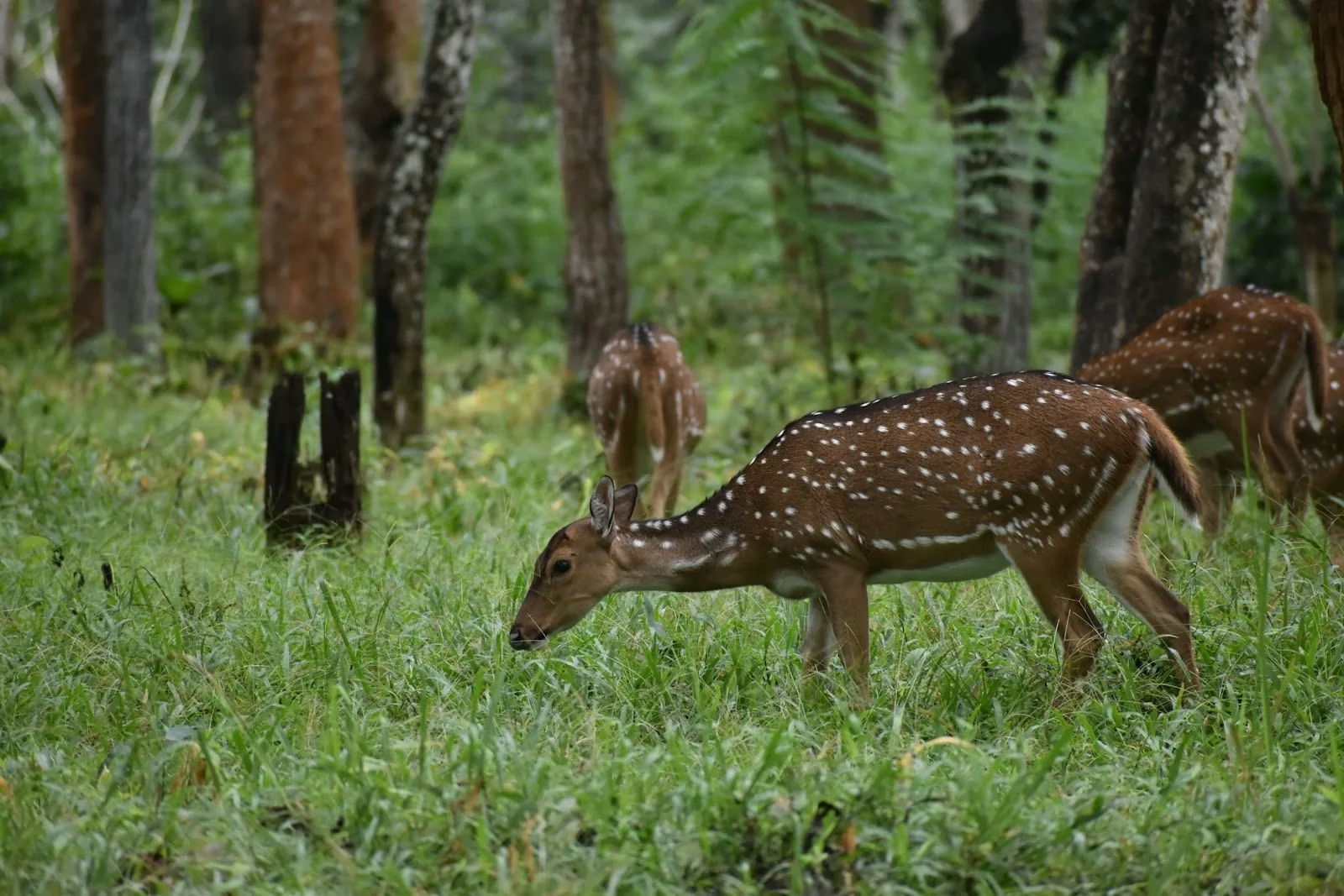
Pilibhit's published list runs tiger, leopard, swamp deer or barasingha, hog deer, spotted deer, sambar, barking deer, nilgai, sloth bear, Bengal florican and hispid hare, with five of India's seven deer species and rich bird life. Rajaji's pages describe elephants, tigers, leopards and deer, with approx. 315 bird species on the Chilla page. Neither side is a population figure: this page states no tiger count for either park, and a permit buys an entry, not an encounter.
Access, stated without ranking
UP Ecotourism publishes New Delhi to Pilibhit at about 365 km and Lucknow at about 252 km, both via Bareilly. No Bareilly-only distance and no travel time is published for them. For Rajaji, the reserve's own pages give Delhi to Chilla about 224 km via NH 334, Dehradun 55 km and Jolly Grant 40 km. Four figures, two reserves, two publishers — set out so a traveller can see them, not so one can be declared nearer, and no hour estimate is attached to any.
Who each park suits
Rajaji suits a trip anchored in Uttarakhand — Haridwar, Rishikesh or Dehradun — with six zones, a riverine landscape and an extension beside a northern itinerary. Pilibhit suits a plains itinerary built around Pilibhit, Bareilly and Lucknow, with Terai grassland, two published departure points and the barasingha record in its own pages. Families, photographers and first-timers appear on both lists; what decides it is your starting point, your dates and which calendar offers your day.
What to confirm before you decide
- Which live calendar offers your dates — the reserve's own portal for Rajaji, UP Ecotourism for Pilibhit.
- Which shift window your Pilibhit booking actually issues, since two official pages print different evening times.
- Which departure point or gate your permit names, and where you will sleep relative to it.
- Which identity document each system asks for — the passport rule belongs to Rajaji, not to Pilibhit.
What this page will not claim
Six abstentions. No verdict about which reserve is better. No tiger count for either park. No merged area figure for Pilibhit, because 727 and 730.2498 are reported as a conflict. No fixed season date where the sources conflict, and no invented shift window — both Pilibhit evening versions are printed and neither is preferred. No invented distance or drive time, and no ranking of the published ones. And no passport rule attributed to Pilibhit, because none was found.
Where to read next
For the rest of this comparison series, the Dudhwa comparison, the Sariska comparison and the Bandhavgarh comparison; for the wider field, Rajaji versus other Indian tiger reserves. For the Rajaji side of the transaction, the official portal and process guide, and for what a Rajaji day visit is before you compare it, the jungle safari overview. The two companion pages are the Ahmedabad, Kolkata and Indore route page and the Pench comparison. Sources checked 14 November 2026.
Rajaji versus Pilibhit: questions answered
Is Pilibhit better than Rajaji for tigers?
This page does not rank them and prints no tiger count for either. What the official records differ on is setting and scale: Pilibhit sits in the Terai Arc Landscape of the upper Gangetic Plain on the India-Nepal border, with the Sharda river and Sharda Sagar reservoir, sal forests, tall grasslands and swamps, while Rajaji is a Shivalik and Ganga riverine landscape in Uttarakhand. Both publish permits rather than sightings, and a permit buys an entry, not an encounter.
How far is Pilibhit from Delhi?
Two published figures, each with its own publisher, and no drive time attached to either. UP Ecotourism gives New Delhi to Pilibhit as about 365 km and Lucknow as about 252 km, both via Bareilly. Rajaji's own pages give Delhi to Chilla about 224 km via NH 334: https://rajajitigerreserve.uk.gov.in/chilla-zone.aspx. Different states, different endpoints, different sources — this page states the distances and does not rank them or convert them into hours.
When are Rajaji and Pilibhit open?
Both publish a 15 November to 15 June season. Rajaji's pages disagree with themselves — most say 15 November to 15 June while the booking page's Chilla line says 15 October to 15 June — so its live calendar decides your date. Pilibhit splits the season into 15 November to 31 March and 1 April to 15 June, with 16 June to 14 November as the complementary period. Its shift times conflict between two official pages, so confirm the window you are given at booking: https://upecotourism.in/OnlySafariBooking.aspx.
Can I combine Rajaji and Pilibhit in one trip?
Nothing stops you planning both, but they are two tiger reserves in two states with two booking systems and no combined permit. Rajaji is booked on the reserve's own portal: https://rajajitigerreserve.uk.gov.in/jungle-safari-booking.aspx. Pilibhit is booked through the UP Ecotourism safari booking page or the reserve's own site, with the departure point chosen in the flow: https://pilibhittigerreserve.in/. This page prints no distance or travel time between the two parks, because none was verified for it.
Which is better for a family?
That is a question about your starting point rather than about the parks. Travellers in Uttarakhand compare the Shivalik and riverine option with the Terai grassland option on the border; family logistics turn on the departure point, the published shifts and which live calendar offers your day. Read the two bodies side by side, confirm the identity documents each system asks for, and send group-specific questions through each reserve's official contact route. Sources checked 14 November 2026.