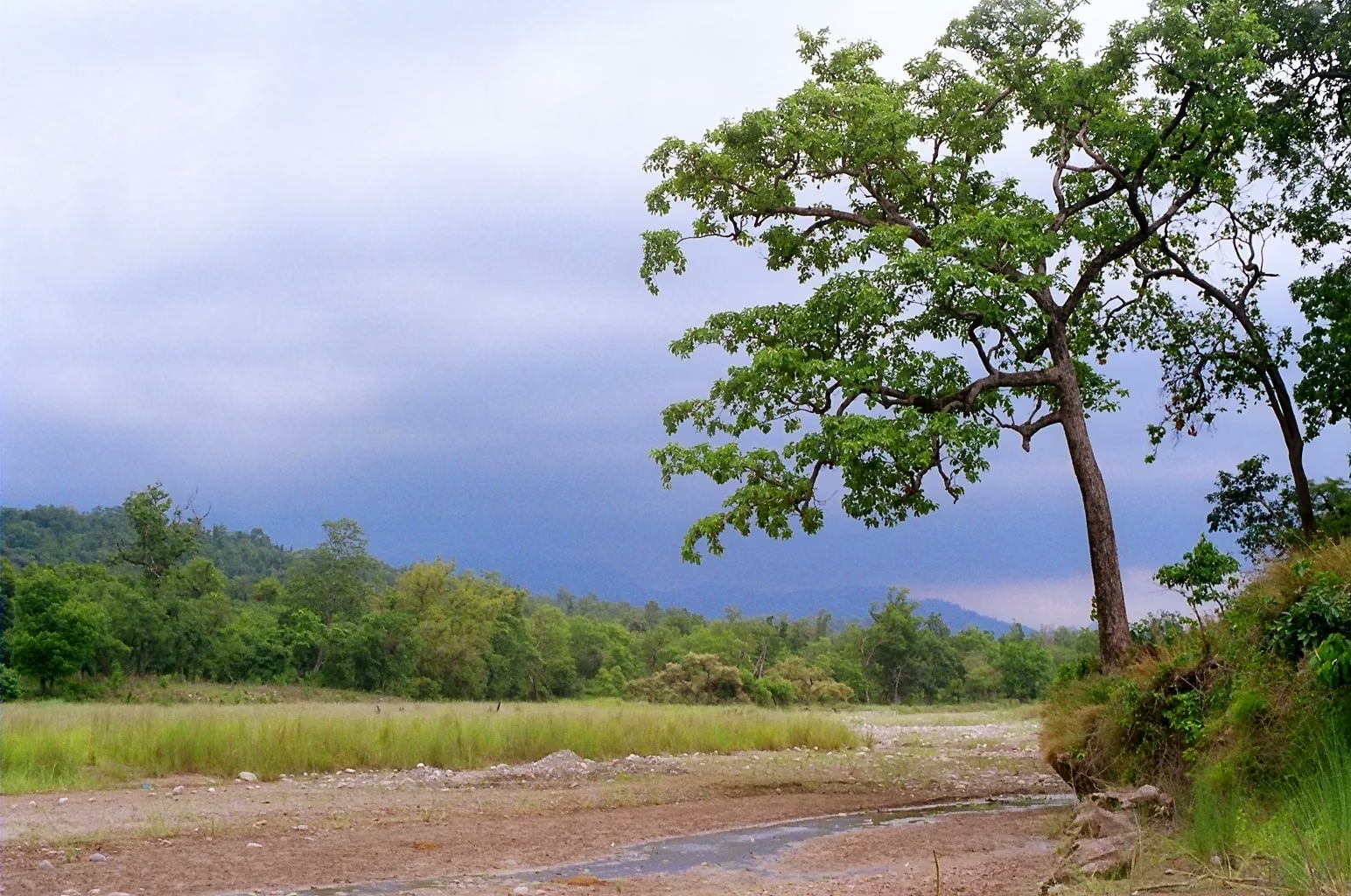
Two reserves that could not look less alike: Rajaji in the Shivalik foothills and Ganga riverine belt of Uttarakhand, and Sundarbans in the lower Gangetic delta of West Bengal, a maze of estuaries, river channels and creeks where the only way in is by boat. Both are official tiger reserves with their own booking systems and published rules. This page sets the two records side by side and stops there: no verdicts, no counts, and no figure the sources do not print.
Sources checked on 21 November 2026: the Sundarbans official reserve site, its How to Reach page, boat booking page and rules page, the official e-ticket portal, the NTCA reserve table and Sundarbans brief, and Rajaji's own booking page and FAQ; plus this site published guides, linked below.
Location and landscape
Sundarbans Tiger Reserve lies in the coastal districts of West Bengal, in South 24-Parganas and part of North 24-Parganas, at the southernmost extremity of the lower Gangetic delta bordering the Bay of Bengal. The NTCA brief describes a maze of estuaries, river channels and creeks encompassing 105 islands. The reserve is bounded east by the international boundary with Bangladesh, formed by the Harinbhanga, Raimangal and Kalindi rivers; south by the Bay of Bengal; west by the Matla; and north-west by the Bidya and Gomdi. The NTCA brief records 140 plant species under 59 families and 101 genera. Rajaji is the Shivalik and Ganga counterpart, with sal forest, riverine vegetation and the 820.42 sq km national park of 1983.
Size and designations
The NTCA table gives Sundarbans core 1,699.62 sq km, buffer 885.27 sq km and total 2,584.89 sq km. The official site records that Sundarban National Park was declared a UNESCO World Heritage Site in 1987, that the Sundarban Biosphere Reserve was constituted in 1989 and received UNESCO Man and the Biosphere recognition in November 2001, and that the Indian Sundarban was designated a Ramsar Site in 2019, the 27th in India, covering almost 423,000 hectares. The NTCA table records the protected area notification in 1973-74 and the tiger reserve notification in 2007. Rajaji history is shorter: the 1983 intent notification merged the Rajaji, Motichur and Chilla sanctuaries, and the 2015 buffer took the reserve to 1,075 sq km.
Boat access and booking
Sundarbans has no jeep safari in the Rajaji sense. The official site states that tourists can enter the tiger reserve only with a booked registered boat, that the boats carry ecotourism guides, and that the only way to get around inside is by boat or launch. Boarding points are Godkhali and Dhamakhali; there is private parking at Godkhali Jetty Ghat. The rail route is to Canning from Sealdah, with EMU trains about every hour; the nearest airport is Netaji Subhash Chandra Bose International at Dumdum; buses run to Sonakhali and Godkhali from Esplanade and to Dhamakhali from Sealdah, Babughat, Barasat and Science City; and a ferry connects Godkhali or Dhamakhali to Sajnekhali. Entry permission can be obtained from the Office of the Field Director at Canning and at Sonakhali, Bagna and Sajnekhali. The official e-ticket portal handles boat booking, entry at Counter No. 1 near the main gate exit, and payment by card or netbanking.
Season, timings and the stale notice
The season record does not agree, and all of it is reported. The official site says October to March is the best season for a Sundarban tour. The official e-ticket portal says eco-tourism will be open throughout the year. The same portal still carries a COVID-era notice saying the reserve is temporarily closed until further notice, which is archival rather than a current season statement. The pages checked publish no fixed boat departure time; the booking portal is the authority for your date. Rajaji publishes three season statements that do not agree: 15 November to 15 June on most pages, a Chilla line of 15 October to 15 June on the booking page, and a reversed 15 June to 15 November in the FAQ.
Rules and the foreign-permit conflict
The Sundarbans rules page requires the prescribed number of tourists per boat, forbids the crew from deviating from department routes without permission, bans loud music and requires silence inside the forest, bans waste and single-use plastic, allows tourists to get down only at camps open for tourism, prohibits swimming, diving and fishing, and applies the Indian Forest Act 1927, the Wildlife Protection Act 1972 and NTCA rules. Guides must wear an ID card, inform guests of the rules and not promote private businesses. The foreign-permit record conflicts: the How to Reach page says no special permits are required for foreigners, while the Boat Booking page says a special permit is required for foreigners and can be obtained from the Joint Secretary, Forest Department, Writers Building, Kolkata. Both statements are printed here; this page does not choose between them. Rajaji rules are published: a valid permit and photo ID, a non-transferable permit, approved vehicles only, no private vehicles, mobile phones prohibited inside the safari zones under a Supreme Court order dated 17.11.2025, no flash photography, no food, plastic-free, no smoking or alcohol, staying in the vehicle and no feeding.
Wildlife, without counts
The NTCA brief names the tiger, fishing cat, estuarine crocodile, Gangetic dolphin, Irrawaddy dolphin, king cobra, water monitor lizard, river terrapin, olive ridley, green sea turtle and hawksbill turtle among the fauna, and describes the mangroves as nurseries for shellfish and finfish. Rajaji material lists elephants, tigers, leopards and deer, with around 315 bird species. Species lists are not population counts, and no sighting is promised by either permit.
Access
Sundarbans official pages publish the route rather than a kilometre table: Kolkata is the nearest major city, reached by train to Sealdah or Howrah; the nearest railhead is Canning; the nearest airport is Netaji Subhash Chandra Bose International; buses run to Sonakhali and Godkhali from Esplanade and to Dhamakhali from Sealdah, Babughat, Barasat and Science City; and a ferry reaches Sajnekhali. No official kilometre figure from Kolkata to Godkhali was found on the pages checked, so this page prints none. Rajaji Chilla figures are published: Delhi 224 km via NH 334, Jolly Grant 40 km and Dehradun 55 km.
Who each suits
Sundarbans suits travellers based in Kolkata who want a boat-only mangrove landscape, a guided day on the creeks and a reserve whose official pages publish the boarding points and boat rules. Rajaji suits travellers based in Dehradun, Haridwar or Rishikesh who want the Shivalik and Ganga setting, the elephant landscape and a zone decision that has to be confirmed against the live calendar. Neither is a better holiday in the abstract; each is a different starting point.
Confirm before you pay
- That your boat is registered and booked through the official e-ticket portal or an authorised operator.
- That you know whether you board at Godkhali or Dhamakhali, and how you reach it.
- That you have the current season statement confirmed, because the site carries three different versions.
- That you have the foreign-permit question confirmed if it applies to your passport.
- That you have read the boat, plastic, camp and swimming rules before boarding.
Where to read next
The other comparisons in this series are Rajaji versus Melghat and Rajaji versus Manas. For the wider set, Rajaji against other Indian tiger reserves, Corbett, Sariska, Dudhwa, Bandhavgarh, Pilibhit, Pench, Kanha, Kaziranga, Satpura, Tadoba-Andhari, Nagarhole, Valmiki, Bandipur, Periyar and Mudumalai. For the Rajaji transaction, the official portal and process guide and the jungle safari guide; for the official charges, the per-zone price guide; for Rajaji zone selection, the safari gates and zone entry guide and which safari zone. Sources checked 21 November 2026.
Rajaji versus Sundarbans: questions answered
Is Sundarbans better than Rajaji for tigers?
This page does not rank them and prints no tiger count for either. Sundarbans lies in the lower Gangetic delta of South 24-Parganas and part of North 24-Parganas in West Bengal, a maze of estuaries and creeks; Rajaji is a Shivalik and Ganga riverine landscape in Uttarakhand. Both publish permits rather than sightings, and a permit buys an entry, not an encounter.
How do I book a Sundarbans safari?
Entry into the tiger reserve is allowed only with a booked registered boat, and boats carry ecotourism guides. The official site links an online boat booking portal, and entry permission can also be obtained from the Office of the Field Director at Canning and at Sonakhali, Bagna and Sajnekhali. Tourists generally use conducted tours run by private operators or the West Bengal Tourism Development Corporation: https://www.eticketsundarbantigerreserve.com/.
When are Rajaji and Sundarbans open?
Rajaji publishes 15 November to 15 June on most pages while its booking page Chilla line says 15 October to 15 June, so its live calendar decides. The Sundarbans official site says October to March is the best season, the booking portal says eco-tourism is open throughout the year, and the same portal still carries a COVID-era notice saying the reserve is temporarily closed. The three statements are reported here, not resolved; confirm the current status before paying: https://www.eticketsundarbantigerreserve.com/.
Do foreigners need a special permit for Sundarbans?
The official pages disagree. The How to Reach page says no special permits are required for foreigners, while the Boat Booking page says a special permit is required for foreigners and can be obtained from the Joint Secretary, Forest Department, Writers Building, Kolkata. This page prints both statements and does not choose between them; confirm with the reserve before travel: https://www.sundarbantigerreserve.org/.
Which is better for a family?
That is a question about your starting point rather than about the parks. Families in Kolkata compare the Sundarbans boat option with the Uttarakhand foothill option; logistics turn on the Godkhali or Dhamakhali boarding point, the registered-boat rule, the season statement you rely on and which calendar offers your day. Read the two bodies side by side and confirm the permit and identity rules before booking. Sources checked 21 November 2026.