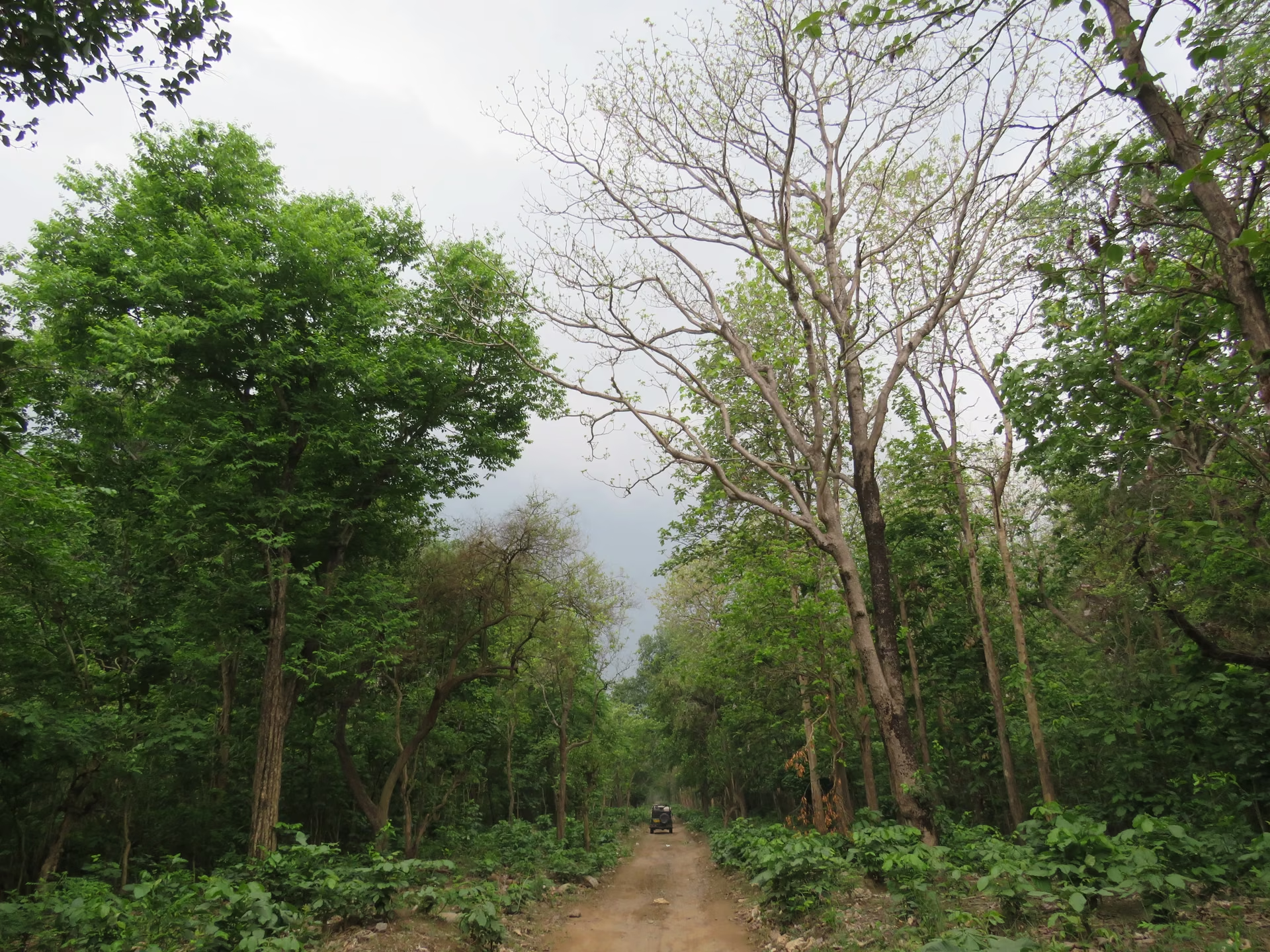
Motichur is the sal-forest gate on the Dehradun-Haridwar highway, and its zone page is one of the clearest documents the site publishes: a location line, an opening line, a best-time line, an access table and an about section in plain words. This page reads that document closely, reports what it says where it disagrees with itself, and links onward instead of reprinting tariff figures.
Sources checked on 17 November 2026: the reserve's own Motichur zone page, its day-visit booking page, its guest-login page and its FAQ; plus this site's own pages, linked below.
What the zone is and where it sits
The location line reads Near Dehradun and Haridwar, Uttarakhand, and the about section calls Motichur the famous gate of Rajaji National Park. The gate and office sit on the Dehradun-Haridwar National Highway near the Motichur over bridge, making it an entry point on that corridor. The reserve lies in the Dehradun, Haridwar and Pauri Garhwal districts in the Shivalik foothills, after the 1983 intent notification that merged the Rajaji, Motichur and Chilla sanctuaries and named the park after C. Rajagopalachari.
The sal forest and the 25 km route
The page describes the safari in one sentence worth keeping: tourists do a safari of about 25 km, and the sal forest here is, in its own words, very amazing in itself. The reserve's shared material puts a conducted tour at generally two to three hours, dependent on sunrise and sunset or on the administration, so the distance and the duration belong together as published ranges rather than as a schedule your morning must obey.
The 1966 sanctuary history and the 90 sq km
The page carries its own history line: the old Motichur Wildlife Sanctuary covers about 90 sq km and was carved out of Dehradun forests in 1966. That sanctuary, with Rajaji and Chilla, is one of the three the 1983 intent notification merged into Rajaji National Park, which in 2015 gained 255.63 sq km of buffer and was declared a tiger reserve of 1,075 sq km under the Wild Life (Protection) Act 1972. The 90 sq km describes the historical sanctuary, not the zone's bookable area, and the two are not converted into one another.
Wildlife and birds, without guarantees
The zone page's wildlife notes are modest and specific: a leopard is sometimes seen in the bushes; small or large herds of elephants are seen in summer with spotted deer, sambar, barking deer and wild boar; and because of the sal forest, woodpeckers are more visible, with hornbills and barbets eating fruit in ficus trees. It adds that with an expert nature guide the leopard sighting can be very good — the reserve's wording about probability, reported as such. The wider reserve list covers tiger, elephant, leopard, jungle cat, bears, hyena, goral and deer, with vultures and hornbills among around 315 bird species reserve-wide. No animal population count and no sighting guarantee appears here.
Season and shifts: three statements
The season material does not agree, and all of it is reported. The opening line says open from 15 November to 15 June and closed for day visit from 16 June to 14 November. The best-time line says summer March to June and winter October to February — different months on the same page, left standing as the page's own wording. The FAQ gives the season in reverse, as open for safari from 15 June to 15 November. Three statements, no invented resolution: the live calendar decides your date, and the published shifts are 6 am to 10 am and 2 pm to 6 pm.
The forest rest house
Motichur FRH is situated in the zone and has two suites. The FAQ is specific about how a stay is requested, and this page is equally specific about its limits: bookings are requested offline by email to director[dot]rajaji[at]gmail[dot]com, subject to availability, mainly for government officials on duty, and may be cancelled for official visits. Nothing on those pages promises a leisure booking, and no such promise is made here — availability is the answer, so do not build a holiday around an unconfirmed rest house.
Booking, identity and the permit rules
The published flow is select date, zone, shift, visitor details with the group leader, payment, day-visit ticket, then print the permit. The guest-login page adds two conditions: for non-Indians, passport as identity proof is mandatory, and online booking only with a static IP, preferably a desktop PC, which may not work on mobile or tablet devices using dynamic IPs. At the gate: a valid permit and photo ID, a non-transferable permit, only Forest Department-approved safari vehicles, no private vehicles, no mobile phones under a Supreme Court order dated 17.11.2025, no flash photography, no food, plastic-free, no smoking or alcohol, staying in the vehicle, no feeding, and no safari before sunrise or after sunset.
Access figures
The zone page publishes three road figures and four railheads: Jolly Grant to Motichur about 35 km, Dehradun about 55 km, Delhi about 224 km via NH 334, with Raiwala, Motichur, Rishikesh and Haridwar as the nearest stations and Jolly Grant as the nearest airport. No drive time is published for any of these legs, and none is invented here.
Who it suits
Motichur suits travellers using the Dehradun-Haridwar highway, visitors drawn to the dense sal forest the page describes, and anyone who values a zone whose own page states its history. Both shifts suit it equally, for anyone who has booked against the calendar rather than a paragraph.
Confirm before you pay
- That your date, zone and shift appear in the live calendar, not a season sentence.
- That the permit names the Motichur gate and your photo ID matches the booking.
- That your connection meets the guest-login page's static-IP, desktop condition.
- That your vehicle is approved, since private vehicles are not allowed.
- That the printed permit travels with you: it is non-transferable and checked at the gate.
The zone-count conflict, explained once
The reserve's pages do not agree on how many safari zones exist, so the disagreement is reported once here for all three guides. The About text says 05 zones/ranges; the About cards and availability table list six — Chaurasi Kutiya, Chilla, Motichur, Haridwar, Chillawali, Ramgarh; the FAQ says four — Chilla, Chillawali/Mohand, Ranipur, Motichur; the booking page lists six with tariffs; the home page shows five cards, omitting Ramgarh. Two entries carry qualifications: the FAQ says Chaurasi Kutiya is not a safari zone, open in daytime year-round with entry possibly restricted for restoration, while the booking page lists it with a zero vehicle charge; the About card for Ramgarh says it is likely to be thrown open while the booking page lists it with a tariff. This page asserts no single count: the booking page and the live calendar name what can be bought on your date.
What this page will not claim
The abstentions are explicit. No price — the zone page's entry, vehicle, driver and online charges with GST tiers belong to the per-zone price guide. No animal population count and no sighting guarantee. No single season, because three official statements conflict. No single zone count, because five sources disagree. No invented kilometre or drive time. And no rest house promise: the email route is availability, not entitlement.
Where to read next
The two companion zone guides are the Chillawali and Mohand guide and the Ranipur gate and Haridwar zone guide. For choosing between zones, which safari zone and the safari gates and zone entry guide; for the transaction, the official portal and process guide and the booking documents and permit guide; for the official charges, the per-zone price guide; for Dehradun as a base, jungle safari in Dehradun. Sources checked 17 November 2026.
Motichur zone: questions answered
Where is Motichur gate and how do I reach it?
The official zone page places the Motichur zone gate and office on the Dehradun-Haridwar National Highway near the Motichur over bridge. By road the same page gives Jolly Grant to Motichur about 35 km, Dehradun about 55 km and Delhi about 224 km via NH 334, and by train it names Raiwala, Motichur, Rishikesh and Haridwar as the nearest stations, with Jolly Grant as the nearest airport: https://rajajitigerreserve.uk.gov.in/motichur-zone.aspx. Confirm your reporting gate on the permit rather than on a distance.
Is Motichur good for leopard sightings?
The zone page describes the forest as very dense and says a leopard is sometimes seen in the bushes, adding that with an expert nature guide the sighting chance can be very good. That is the reserve's own wording about probability in suitable habitat, not a guarantee: no sighting is promised by this page or by any permit, and the same page lists the animals you may meet rather than an assurance of meeting them.
How long is the Motichur safari?
The zone page states that tourists do a safari of about 25 km through the sal forest. The reserve's shared booking material describes a conducted tour as generally two to three hours, dependent on sunrise and sunset or on the administration, so treat the distance and the duration as published ranges that the day itself decides: https://rajajitigerreserve.uk.gov.in/jungle-safari-booking.aspx.
When is Motichur open and what are the timings?
The page carries three statements that do not agree, and all three are reported here rather than reconciled. The opening line says open for tourists from 15 November to 15 June and closed for day visit from 16 June to 14 November; the best-time line says summer March to June and winter October to February; and the reserve's FAQ gives the season in reverse as open for safari from 15 June to 15 November: https://rajajitigerreserve.uk.gov.in/FAQ.aspx. The published shift windows are 6 am to 10 am and 2 pm to 6 pm, and the live calendar is the authority for your date.
Can I book Motichur online and what ID do I need?
Yes. The published flow on the booking page is select date, zone, shift, visitor details with the group leader, payment, then print the permit: https://rajajitigerreserve.uk.gov.in/jungle-safari-booking.aspx. The guest-login page states that for non-Indians passport as identity proof is mandatory and that online booking can be done only with a static IP, preferably a desktop PC: https://rajajitigerreserve.uk.gov.in/VisitorAuth/GuestLogin.aspx. A valid permit and photo ID are required at the gate, and the permit is non-transferable. Sources checked 17 November 2026.