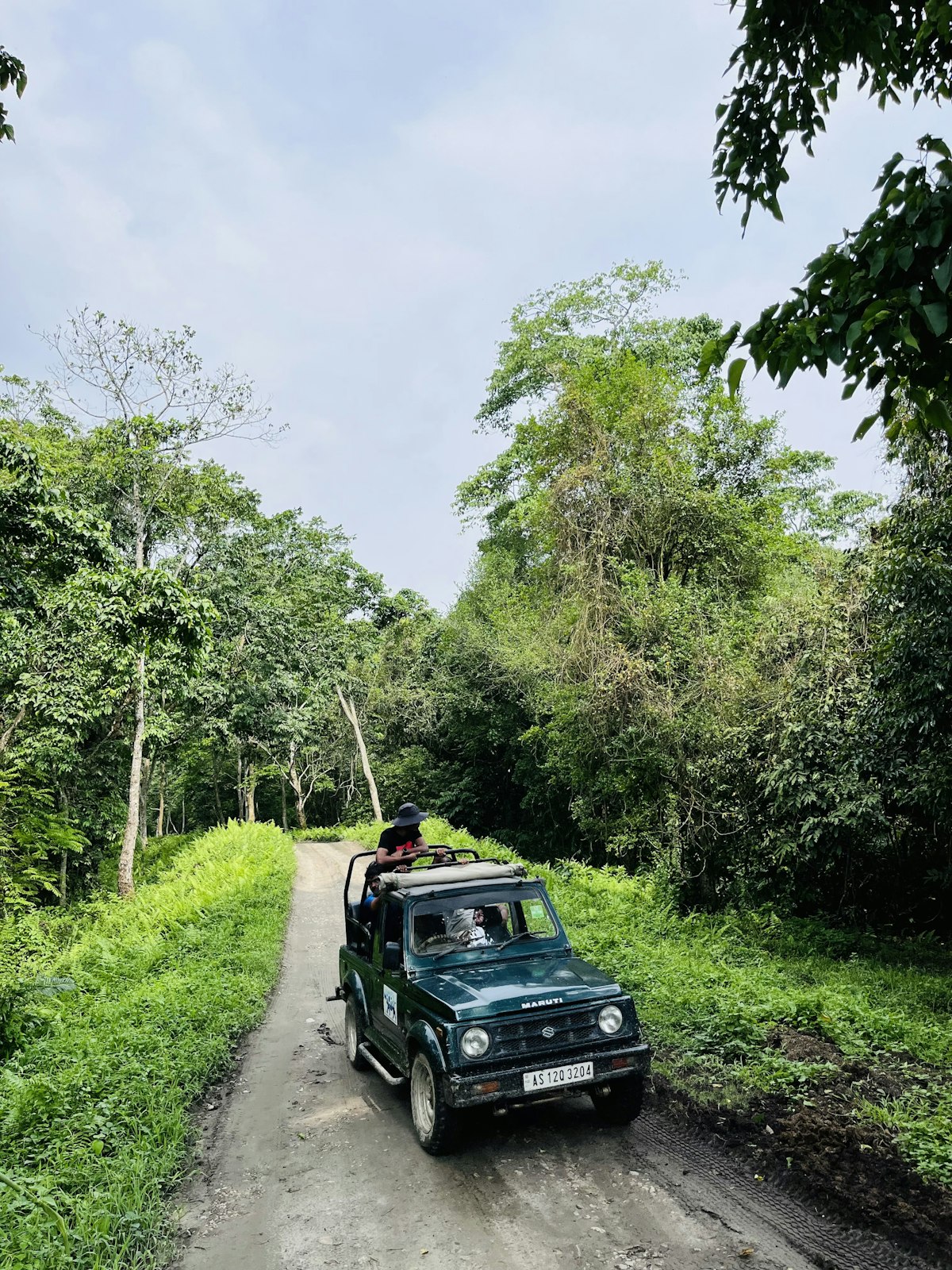
"Rajaji National Park jungle safari" is the question this page answers, and it answers it as an overview: what the day visit is, which zones the reserve publishes, how the shifts work, and where to read the detail. It is deliberately not a second booking-process page and not a second gate guide. Those pages are linked below and hold the step-by-step material this one leaves to them.
Sources checked on 6 November 2026: the reserve's own website, its day-visit booking page, its Chilla zone page and its Chaurasi Kutiya zone page; plus this site's own published pages, linked at the foot of this article.
What a Rajaji jungle safari is
It is a day visit by jeep into one of the reserve's published zones, booked through the official portal and checked at a gate with a printed permit. The reserve's own pages give it its frame: the home page records that Rajaji National Park was notified in 1983 after merging the Rajaji, Motichur and Chilla sanctuaries, spread over 820.42 sq km, and that in 2015 a further 255.63 sq km of adjacent forest was added as buffer, taking the declared Rajaji Tiger Reserve to 1,075 sq km.
The clearest description of the activity itself sits on the Chilla material. The Chilla complex provides an eco-friendly bus, a safari by the park jeep run by locals and a small interpretation centre-library, and the circuit runs about 2.5 hours through Mundal, Mithawali and Khara. The booking page puts the Chilla track at about 36 kilometres. That is the product: a fixed circuit, a vehicle, a few hours of forest, and a gate you report to.
The six zones at a glance
The official pages publish six day-visit zones: Chaurasi Kutiya, Chilla, Motichur, Haridwar, Chillawali and Ramgarh. The home page and the booking page's tariff table both name them. Read them as six reporting points rather than six views of the same drive:
- Chilla — in Pauri Garhwal near Haridwar, 249 sq km on the east bank of the Ganga, the zone whose timings the portal publishes in detail.
- Motichur — about 90 sq km, carved out of the Dehradun forests in 1966, the forested option on the Dehradun side.
- Haridwar — the zone at Haridwar itself, reported through the Ranipur gate, closest to the city of the same name.
- Chillawali — the Mohand tourism zone on the Delhi-Dehradun highway, with a 13 km drive through the Chillawali range to the Dholkhand FRH.
- Chaurasi Kutiya — at Rishikesh, the zone whose own page says Chaurasi Kuti is always open for tourists throughout the year.
- Ramgarh — Asharodi Gate, Dehradun, described by its page as 10 to 20 minutes from Dehradun and likely to be thrown open to tourists, so this page never calls it definitely open.
Suitability follows logistics and landscape rather than a ranking: which gate your accommodation serves, whether you want the river side or the Dehradun side, and what the calendar offers on your date. The which-zone page and the gates and zone entry guide carry the detail.
How the shifts work
Jeep safari is available in the morning and evening, and the portal asks you to pick one when both are offered. The entry bands printed on the Chilla and day-visit page run in three seasonal stretches:
- 15 November to 15 February: morning entry 6:30 AM to 8:00 AM and evening 1:30 PM to 3:00 PM; last exit 10:30 AM and 5:30 PM.
- 16 February to 15 April: morning 6:00 AM to 7:30 AM and evening 2:00 PM to 3:30 PM; last exit 10:00 AM and 6:00 PM.
- 16 April to 15 June: morning 5:30 AM to 7:00 AM and evening 3:00 PM to 4:30 PM; last exit 9:30 AM and 7:00 PM.
Those bands are published on that page, so treat them as its timings rather than a rule for every zone. Two rules travel with any shift: reach the gates 20 minutes before the last entry timing, and late arrivals may not be entertained, with no refund of fees deposited.
What you may see, and what is not promised
The reserve's own pages list elephant, tiger, leopard and deer, and the Chilla page puts the park at approx. 315 bird species. The booking page's do-and-don't list tells visitors not to be disappointed if they do not see a tiger: the sighting is not the product.
Two things follow. No sighting is guaranteed by this page or by a permit. And no elephant ride is listed on the official day-visit page, which describes a jeep safari: elephants are wildlife you may meet on the drive, not a bookable activity.
Season, and two published inconsistencies
The site banner and most zone pages say the reserve is open for tourists from 15 November to 15 June, and the Chilla page prints day visit as closed from 16 June to 14 November. Two other pages say something different, and this page flags those conflicts instead of resolving them. The booking page's own Chilla Open/Closed line says the Chilla Range is open from 15 October to 15 June and closed for day visit from 16 June to 14 October. The Chaurasi Kutiya page says Chaurasi Kuti is always open for tourists throughout the year.
In both cases the working answer is the same: the live booking calendar for your date is the authority. Confirm that your date, zone and shift appear there before you plan transport around them.
The booking flow in brief
The published sequence is short: date, zone, shift, visitor details with the group leader, payment, day-visit ticket, then print the permit. Two conditions sit beside it. Non-Indian visitors must carry a passport as identity proof, and the guest-login page states that online booking can be done only with a static IP, preferably on a desktop PC, and may not be possible using mobile and tablet devices using dynamic IPs. The full sequence, the documents and the failure points belong to the official portal and process guide rather than to this overview.
If Corbett comes up in the same conversation
Rajaji and Jim Corbett are separate reserves with separate permits, and no official distance or drive time between them is published in the sources used here, so none is printed here. The comparison belongs to the Rajaji and Jim Corbett comparison, and a two-park week is worked through in the combo itinerary.
What this page will not claim
Six abstentions. No sighting guarantee for any animal. No elephant-ride product, because the official day-visit page does not list one. No price, because the tariff belongs to the live portal on the day you book. No timing generalised from the Chilla bands to zones that publish their own, and no season resolved where the reserve's own pages disagree. And no transfer distance or drive time the official pages do not print.
What to read next
For choosing among the zones, which safari zone and the gates and zone entry guide; for the reporting point, which gate; for where everything sits, the map and ranges page; for what the official tariff displays, entry fees, timings and permits; and for the transaction itself, the official portal and process guide with the tickets guide beside it. From a base city, read jungle safari in Haridwar, Rishikesh and Dehradun, with jungle safari across Uttarakhand for the state-level picture. The two companion pages are the booking office and official website page and the refreshed safari booking guide. Sources checked 6 November 2026.
Rajaji jungle safari: questions answered
What is a Rajaji National Park jungle safari?
It is a day visit in a jeep through one of the reserve's published zones. The official booking page describes a Chilla safari of about 36 kilometres, and the Chilla zone page describes an eco-friendly bus, a safari by the park jeep run by locals and a small interpretation centre-library, with a circuit of about 2.5 hours through Mundal, Mithawali and Khara: https://rajajitigerreserve.uk.gov.in/chilla-zone.aspx. The flow published for it is date, zone, shift, visitor details, payment, then print the permit: https://rajajitigerreserve.uk.gov.in/jungle-safari-booking.aspx.
Which zones can be booked for a jungle safari?
The official pages publish six day-visit zones: Chaurasi Kutiya, Chilla, Motichur, Haridwar, Chillawali and Ramgarh. The home page and the booking page's tariff table both name them. Availability is date and zone dependent, so only choose from what the live calendar offers on your date, and check the zone and gate guide on this site for what each one is like before you choose.
When is Rajaji National Park open for safari booking?
The site banner and most zone pages say 15 November to 15 June, but the booking page's own Chilla Open/Closed line says the Chilla Range is open from 15 October to 15 June and closed for day visit from 16 June to 14 October: https://rajajitigerreserve.uk.gov.in/jungle-safari-booking.aspx. The Chaurasi Kutiya page separately says Chaurasi Kuti is always open for tourists throughout the year: https://rajajitigerreserve.uk.gov.in/chaurasi-kutiya-zone.aspx. This page does not resolve those conflicts; the live booking calendar for your date is the authority.
What time do the morning and evening safaris run?
The Chilla and day-visit page publishes three entry bands for its gypsy safaris: 15 November to 15 February has morning entry 6:30 AM to 8:00 AM and evening 1:30 PM to 3:00 PM, with last exit 10:30 AM and 5:30 PM; 16 February to 15 April has morning 6:00 AM to 7:30 AM and evening 2:00 PM to 3:30 PM, with last exit 10:00 AM and 6:00 PM; and 16 April to 15 June has morning 5:30 AM to 7:00 AM and evening 3:00 PM to 4:30 PM, with last exit 9:30 AM and 7:00 PM. Those bands are published on that page, so do not generalise them to zones that publish their own timings.
Will I see a tiger or an elephant?
No sighting is promised here, and none is published by the reserve. The official day-visit page describes a jeep safari and does not list an elephant ride, so elephants are wildlife you may see rather than a product you can buy. The reserve's own do and don't list tells visitors not to be disappointed if they do not see a tiger, which is the official position: go for the forest, the grassland and the drive, and treat any animal encounter as a bonus. Sources checked 6 November 2026.