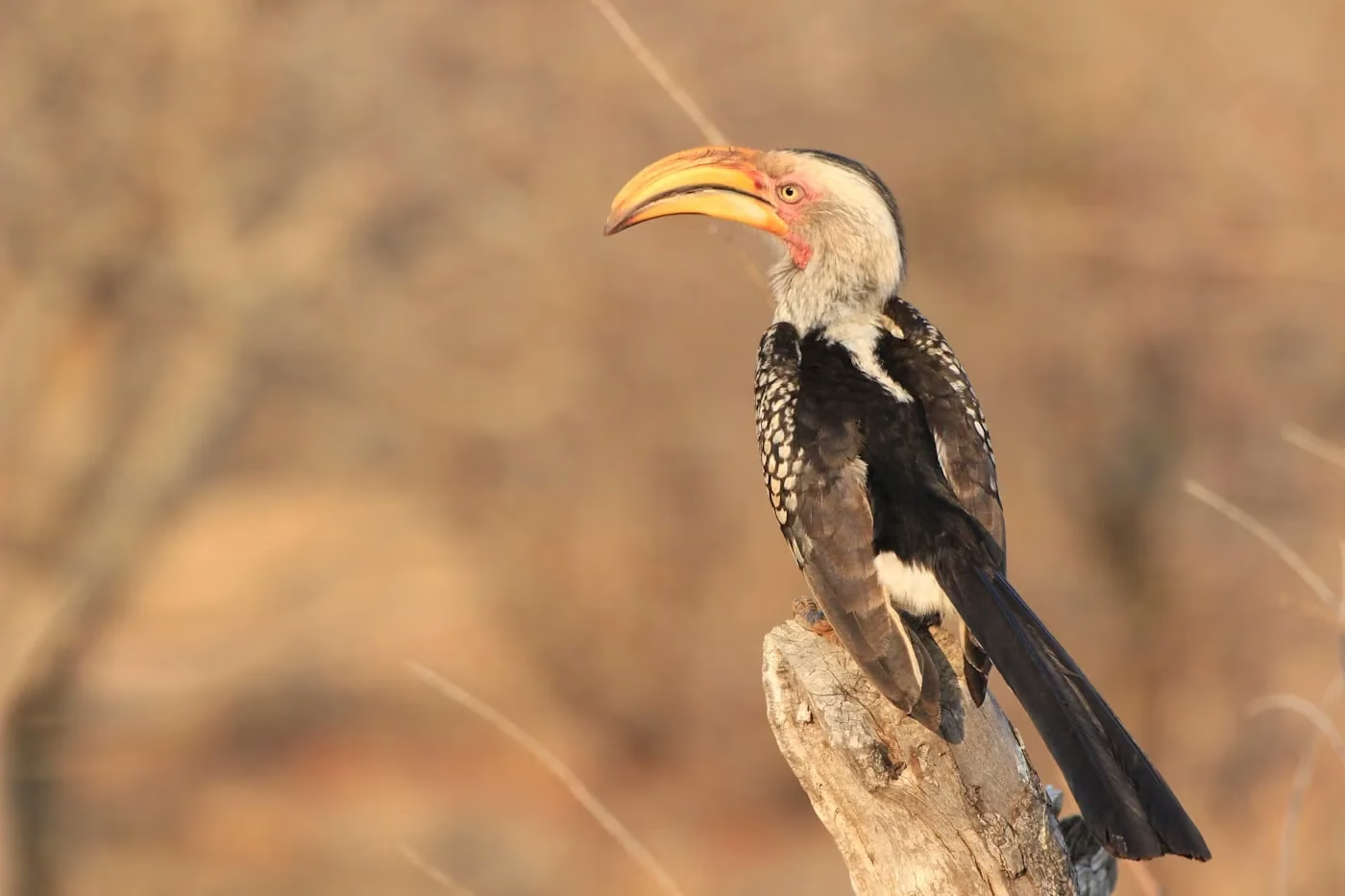
Two reserves in two very different settings: Rajaji in the Shivalik foothills and Ganga riverine belt of Uttarakhand, and Pakke in the Eastern Himalayan foothills of Arunachal Pradesh, between the Kameng and Pakke rivers, where hornbills and semi-evergreen forest define the landscape. Both are official tiger reserves with their own booking systems and published rules. This page sets the two records side by side and stops there: no verdicts, no counts, and no figure the sources do not print.
Sources checked on 23 November 2026: the Pakke official about page, its safari booking page and How to Reach page, the NTCA reserve table and Pakke brief, and Rajaji's own booking page and FAQ; plus this site published guides, linked below.
Location and landscape
Pakke lies in the Pakke Kessang district of Arunachal Pradesh, in the undulating foothills of the Eastern Himalayas at elevations from 150 m to 2,000 m. The reserve is bounded by the Kameng or Bhareli river in the west and north and the Pakke river in the east; it adjoins the Papum Reserve Forest to the east, Nameri National Park in Assam to the south, the Doimara Reserve Forest and Eaglenest Wildlife Sanctuary to the west, and the Tenga Reserve Forest to the north. The habitat types are lowland semi-evergreen, evergreen and Eastern Himalayan broadleaf forest, with 343 woody species of flowering plants recorded in the lowlands and major emergents including Tetrameles nudiflora, Ailanthus grandis and Altingia excelsa. Rajaji is the Shivalik and Ganga counterpart, with sal forest, riverine vegetation and the 820.42 sq km national park of 1983.
Size and notification history
Pakke official pages give two area sets, and they are kept apart. The NTCA table gives core 861.95 sq km, buffer 515.00 sq km and total 1,276.95 sq km; the official about page describes a reserve of 862 sq km. The history runs from Pakhui Reserve Forest on 1 July 1966, through the game reserve of 28 March 1977, the renaming as Pakhui Wildlife Sanctuary in 2001, and the declaration as Pakhui Tiger Reserve on 23 April 2002 as the 26th Tiger Reserve under Project Tiger. The NTCA table records the protected area notification in 1999-20 and the tiger reserve notification in 2012. Those are different layers, and none is merged here. Rajaji history is shorter: the 1983 intent notification merged the Rajaji, Motichur and Chilla sanctuaries, and the 2015 buffer took the reserve to 1,075 sq km.
Safari zones, timings and capacity
Pakke publishes jeep safari zones at Seijosa, with West Bank Khari, West Bank Mobusa and West Bank Langka, and at Tipi, with Bhalukpong Ghat to Diji. The jeep carries a maximum of six persons, described as four adults and two children between five and twelve years. Jeep safari timings are 6:00 to 9:00 am and 1:30 to 5:00 pm, with a note that the timing varies with the season. The elephant safari runs at Khari Camp from 6:00 to 11:30 am and carries a maximum of four persons per trip. Permit, guide and guard fees are paid by the guest on the spot, and the Tipi zone involves an extra boat charge for crossing the Kameng river. Rajaji publishes shifts of 6 am to 10 am and 2 pm to 6 pm, with a conducted tour generally two to three hours.
Season, booking and rules
Pakke has a sub-tropical climate: cold weather from November to March, temperatures from 12 to 36 degrees Celsius, annual rainfall of about 2,500 mm, rain predominantly from the south-west monsoon in May to September and the north-east monsoon from November to April, with October and November relatively dry. The official pages checked publish no fixed closure date; the safari timing is noted as season-dependent, so the booking page is the authority for your date. Rajaji publishes three season statements that do not agree: 15 November to 15 June on most pages, a Chilla line of 15 October to 15 June on the booking page, and a reversed 15 June to 15 November in the FAQ. Pakke booking runs through the official safari page, with jeep and elephant safaris kept separate. The pages checked publish no passport rule and no private-vehicle rule, so this page does not borrow Rajaji rules for Pakke.
Wildlife, without counts
The Pakke official about page records at least 40 mammal species, including tiger, leopard, clouded leopard, jungle cat, wild dog, jackal, Himalayan black bear, binturong, elephant, gaur, sambar, hog deer, barking deer and wild boar; 296 bird species, including the white-winged wood duck, ibisbill and Oriental bay owl; 36 reptile species and 30 amphibian species; and an estimated 500 butterfly species. The reserve is known for hornbills, with roost sites of wreathed and great hornbills on the river banks. Rajaji's material lists elephants, tigers, leopards and deer, with around 315 bird species. Species lists are not population counts, and no sighting is promised by either permit.
Access
The Pakke How to Reach page publishes the figures: Tezpur to Seijusa is 64 km and Guwahati is 240 km; the nearest airport is Tezpur at 64 km, Itanagar at 130 km and Guwahati at 240 km; the nearest railway station is Rangapara, about 50 km from Seijusa. By road, the route is National Highway 52, the Tezpur to Lakhimpur road, up to Soibari and then through Itakhola and Balijuri; Soibari is connected with Tezpur, Rangapara, Guwahati, Bhalukpong and Bomdila. Rajaji Chilla figures are published: Delhi 224 km via NH 334, Jolly Grant 40 km and Dehradun 55 km. No drive time is published for either set, and none is invented here.
Who each suits
Pakke suits travellers based in Tezpur, Guwahati or the Arunachal foothills who want a hornbill forest, a jeep or elephant safari at Seijosa or Tipi, and a reserve that publishes its zones and capacity. Rajaji suits travellers based in Dehradun, Haridwar or Rishikesh who want the Shivalik and Ganga setting, the elephant landscape and a zone decision that has to be confirmed against the live calendar. Neither is a better holiday in the abstract; each is a different starting point.
Confirm before you pay
- That your date and zone appear on the official Pakke safari page.
- That your group fits the six-person jeep or four-person elephant limit.
- That you have planned the Seijosa or Tipi road leg and any Kameng river boat crossing.
- That you know the permit, guide and guard fees are paid on the spot.
- That you have confirmed the season-dependent timing before you travel.
Where to read next
The other comparisons in this series are Rajaji versus Bhadra and Rajaji versus Nagzira. For the wider set, Rajaji against other Indian tiger reserves, Corbett, Sariska, Dudhwa, Bandhavgarh, Pilibhit, Pench, Kanha, Kaziranga, Satpura, Tadoba-Andhari, Nagarhole, Valmiki, Bandipur, Periyar, Mudumalai, Melghat, Sundarbans and Manas. For the Rajaji transaction, the official portal and process guide and the jungle safari guide; for the official charges, the per-zone price guide; for Rajaji zone selection, the safari gates and zone entry guide and which safari zone. Sources checked 23 November 2026.
Rajaji versus Pakke: questions answered
Is Pakke better than Rajaji for tigers?
This page does not rank them and prints no tiger count for either. Pakke lies in the Pakke Kessang district of Arunachal Pradesh, in the Eastern Himalayan foothills between the Kameng and Pakke rivers, with semi-evergreen and evergreen forest; Rajaji is a Shivalik and Ganga riverine landscape in Uttarakhand. Both publish permits rather than sightings, and a permit buys an entry, not an encounter.
How do I book a Pakke safari?
Pakke safari booking runs through the official Pakke booking page. The jeep zones are Seijosa, with West Bank Khari, Mobusa and Langka, and Tipi, with Bhalukpong Ghat to Diji; the elephant safari is at Khari Camp. The jeep carries up to six people, with four adults and two children aged five to twelve, and the elephant trip carries up to four. Permit, guide and guard fees are paid on the spot: https://www.pakketigerreserve.com/safari-booking-home.
When are Rajaji and Pakke open?
Rajaji publishes 15 November to 15 June on most pages while its booking page Chilla line says 15 October to 15 June, so its live calendar decides. Pakke publishes safari windows of 6:00 to 9:00 am and 1:30 to 5:00 pm, with a note that the timing varies with the season, but no fixed closure date on the pages checked. Confirm the date and zone on the official booking page: https://www.pakketigerreserve.com/safari-booking-home.
Can I combine Rajaji and Pakke in one trip?
Nothing stops you planning both, but they are reserves in different states with separate booking systems and no combined permit. Rajaji is booked on the reserve's own portal: https://rajajitigerreserve.uk.gov.in/jungle-safari-booking.aspx. Pakke is booked on its official page, with jeep and elephant safaris kept separate. This page prints no distance or travel time between the two parks, because no official figure was verified for it.
Which is better for a family?
That is a question about your starting point rather than about the parks. Families in Assam or Arunachal compare the Pakke and Seijosa option with the Uttarakhand foothill option; logistics turn on whether the family takes the jeep or the elephant, the six-person jeep limit, the four-person elephant limit and which calendar offers your day. Read the two bodies side by side and confirm the identity document each system asks for at booking. Sources checked 23 November 2026.