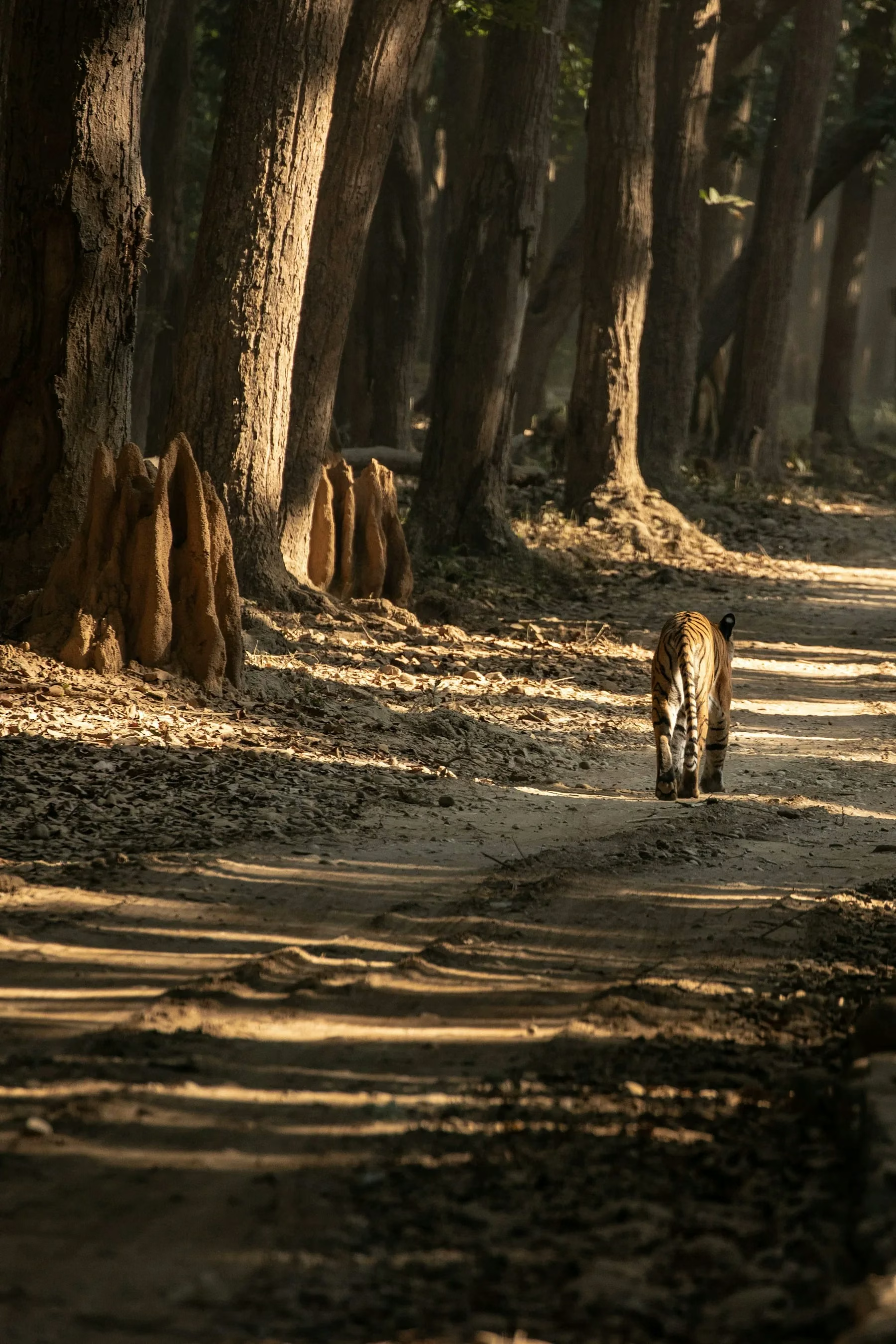
The public record for Rajaji contains several different kinds of Project Tiger funding figures. This page is a ledger. It sets out what three NTCA annual reports record as released to Rajaji for three financial years, what three Annual Plan of Operation orders sanctioned for the following years, and what neither of them contains. A release is not expenditure, a sanction is not a release, a drawing limit is not a transfer, and none of these documents tells you what was bought. No claim of expenditure, causation or outcome is made below.
Sources used, all checked on 24 October 2026: the National Tiger Conservation Authority, Annual Report 2022-23, Annexure III; Annual Report 2023-24, Annexure XVI; Annual Report 2024-25; the sanction orders for the first release of 2024-25 dated 10 December 2024, the mother sanction for 2025-26 dated 25 September 2025 and the mother sanction for 2026-27 dated 2 July 2026; and the Management Effectiveness Evaluation published in 2023 for the sentence on delayed releases. The order for 2024-25 is uploaded as a scanned image rather than searchable text, so its annexure table was read from the pages of the order as filed, while the two mother sanctions checked carry selectable text.
The release line, three years in a row
The annual reports each carry an annexure of Project Tiger sanctions and releases. The 2022-23 report has Annexure III, headed CSS-Project Tiger: Sanction Details for 2022-23, with a tiger-reserve-wise table whose last column is Total Released during 2022-23 in rupees lakhs; against Rajaji it prints 162.64010, in the same list where Corbett is at 578.49000 and the national total is 15,064.93985. The 2023-24 report has Annexure XVI with the same reserve-wise structure and the column Total Released during 2023-24, against which Rajaji is printed at 447.6306, with Corbett at 895.63 in the same table. The 2024-25 report, in Annexure VII under the column Total Released during 2024-25 in rupees lakhs, prints 561.96 against Rajaji at serial 58 of that table, whose last row is footed Net Released at 26,429.99 lakh.
Read as a series, the three numbers rise sharply: 162.64, then 447.63, then 561.96 lakh. It is tempting to read that as a story about commitment or capacity, and this article does not. What is printed is money released in each financial year against the approved plan for that year, and the plans, ceilings and state shares behind those years are not reproduced in the annexures. The series shows what moved, not why, and not what it bought. The 2024-25 report also cross-references its sanction details to Annexure VI in the chapter text while its contents page lists Annexure VI as tiger mortality and the sanction details as Annexure VII, a small internal inconsistency that is noted here only so that anyone chasing the figure in that report starts from the right annexure.
The first installment order of 10 December 2024
For 2024-25 there is a second, differently shaped document. The order of 10 December 2024 is an administrative approval and sanction for the first installment of the year, addressed to the Pay and Accounts Officer and covering Corbett, Rajaji and Project Elephant in the state together, at a scheme cost of 3,358.52 lakh. Its annexure does the arithmetic on its face, row by row, for each of them. For Rajaji it records a total Annual Plan of Operation cost of 1,118.23 lakh, a central share in that plan of 803.61 lakh as proposed by the field directorate, an amount to be released as first installment at 50 per cent of the central share of 401.80 lakh, less an unspent balance of the previous year of 36.58 lakh, and a net release of 365.22 lakh. On the same rows Corbett shows 735.04 lakh with no deduction and Project Elephant shows 126.00 lakh less 18.73 lakh, bringing the state-wide net release to 1,207.53 lakh. Gross, deduction and net are three separate numbers, and the deduction matters, because it shows that a balance left from an earlier year was pulled back before the new money moved.
The unspent adjustment is also why the order cannot be set beside the annual report without care. The same year is reported in the annual report as a full-year release of 561.96 lakh for the reserve, while the first installment order nets to 365.22 lakh. The gap between them, 196.74 lakh by simple subtraction, is not explained by any document read for this article: no second installment order for that year for this state was located, no revised sanction appears in the sources checked on 24 October 2026, and the annual report annexure does not break the figure down by installment. This page therefore prints both numbers, states that the difference is unexplained on this record, and does not infer that a second installment was issued, what it contained, or that the two figures reconcile. Subtracting two numbers is arithmetic; explaining them is not available here.
Two mother sanctions, and what a drawing limit is
The orders for the next two years are mother sanctions, and they behave differently from releases. The order of 25 September 2025 conveys a sanction to release Rs 11,73,55,500, that is 1,173.555 lakh, to the state of Uttarakhand as a drawing limit in the form of a mother sanction during 2025-26, and its plan annexure places against Rajaji a first installment figure of 367.45 lakh, being 50 per cent of the centre share of 734.90 lakh taken against a reserve plan costed at 1,208.04 lakh including the state share. The order of 2 July 2026 conveys Rs 53,076,700, that is 530.767 lakh, to the state for 2026-27 as the first installment, described in the order as 50 per cent of the centre share, and its annexure places 146.747 lakh against Rajaji, alongside 293.75 lakh for Corbett and 90.27 lakh for Project Elephant, which implies a central share for this reserve of 293.494 lakh.
A mother sanction sets the ceiling within which money may be drawn against work proposed in the plan. It does not record a transfer on a date, it does not tell you whether the full ceiling was used, and it is not the same line as a release in an annual report annexure. That is why none of these three order figures is added to the release series above, and why no total appears on this page. A reader who wants a single grand total of money sent to this reserve will not find one here, because the documents do not support one: installment orders, mother sanctions and annual-report release lines are three different instruments covering three different periods with different definitions.
The one thing the record does say about timing
The Management Effectiveness Evaluation published in 2023, based on a field visit from 7 to 9 September 2022, lists among the immediate actionable points for this reserve that there have been delays and inadequate releases of funds by the NTCA and by the state government. That is a dated finding about the period up to 2022. The authority’s 2024 compilation of lessons across five cycles places delayed fund release for this reserve in the column headed subsequent non-compliance over the years till 2022 against the 2018 cycle, and repeats delay and insufficiency of releases in its 2022 row. So two documents, one published in 2023 and one in 2024, record the same subject across the 2018 and 2022 assessments.
Both statements stop at their dates. Nothing read for this article says whether releases have since been timely, and the release series above covers 2022-23 onwards, which is a different period from the one the evaluation criticises. Reporting them side by side is the honest form: an evaluation finding on timing, dated; a compilation column, dated; and three release figures, each tied to a financial year. The point of the ledger is that none of these lines cancels another out.
What is not in any of these documents
- No expenditure for this reserve. None of the three annual reports or the three orders prints a Rajaji-specific expenditure figure, a head-wise utilisation statement or an output financed by these amounts. Releases are published; spending for the reserve is not, in these sources.
- No outcome. Nothing here links any rupee to patrol days, staff, camera traps, fire control, treatment of invasive plants or any other result. This article claims none.
- No plan or foundation status for today. The Annual Report 2024-25 still lists Rajaji among the tiger reserves whose Tiger Conservation Foundation is yet to be constituted, as did the reports for 2022-23 and 2023-24 before it. The same report gives only an aggregate abstract of tiger conservation plans across all reserves, 25 approved and valid, 11 approved but expired, 8 under review, 9 sent to the state for rectification and 7 not submitted out of 59, with no reserve-specific line for this reserve. Those are dated list positions, and this page claims no current status for either, which would need a source newer than these reports.
- No comparison of states or reserves. The annexures are reserve-wise and state-wise for a reason. Pulling a single reserve out of them and comparing it with another would require the plan ceilings behind each line, which are not printed in these annexures.
How to read the next funding figure you see
Three questions separate the documents. Which instrument, because an annual-report release line, an installment order and a mother sanction are three different things with three different verbs. Which financial year, because a December 2024 order speaks to part of 2024-25 and a September 2025 sanction speaks to 2025-26. And which word, since sanctioned, released, drawn and spent are four stages that summaries reduce to funded. The same discipline applies to the other record-based pages on this site: our forest staff article reads the same evaluation for the staffing figures and keeps them in their 2022 context, our riverbed mining explainer keeps a recommendation separate from a clearance in the same way, and the forest fire page draws the line between sanctioned works and completed works, which is the same distinction this ledger applies to money. For what the evaluation itself recommends across management, our invasive weeds evidence page handles the recommendation-versus-implementation gap, and how Rajaji compares covers reserve-to-reserve comparison without borrowing figures from different years.
Project Tiger funding for Rajaji questions answered
How much did the NTCA release to Rajaji in the three years covered here?
Three figures, each from the sanction annexure of an annual report and each stated as released during that financial year in rupees lakhs. The Annual Report 2022-23, in Annexure III headed CSS-Project Tiger Sanction Details for 2022-23, prints 162.64010 against Rajaji under the column Total Released during 2022-23. The Annual Report 2023-24, in Annexure XVI, prints 447.6306 under the column Total Released during 2023-24. The Annual Report 2024-25, in Annexure VII under the column Total Released during 2024-25, prints 561.96 against Rajaji. Those are releases recorded by the authority for three financial years, and they are not expenditure figures.
Is a release the same as money spent?
No, and this article treats them as different things throughout. A release is money moved by the National Tiger Conservation Authority to the state against an approved plan. Expenditure is what was then spent, under which head, and with what result. The documents read here are annual reports and sanction orders; none of them prints a Rajaji-specific expenditure statement, a head-wise utilisation figure for the reserve or an output financed by any of these amounts. So this page publishes releases and sanctions only, and it claims no spending, no works completed and no outcome caused by any amount.
What did the first installment order of 10 December 2024 provide for 2024-25?
It is an installment order rather than a full-year record. The annexure to the order of 10 December 2024 shows for Rajaji an amount to be released as first installment at 50 per cent of the central share of 401.80 lakh, less an unspent balance of the previous year of 36.58 lakh, giving a net release of 365.22 lakh, with Corbett and Project Elephant on separate rows and the state-wide net release at 1,207.53 lakh. The annual report for the same year records a full-year release of 561.96 lakh for the reserve. The gap between the net installment and the full-year figure is not explained by any document read for this article, and this page does not infer that a second installment was issued or what it contained. The arithmetic is printed as it appears in the order.
What are the 2025-26 and 2026-27 orders, and why are they not releases?
They are mother sanctions for the current and coming financial years, and a mother sanction sets a ceiling for drawing rather than recording a transfer. The order of 25 September 2025 conveys a sanction to release 1,173.555 lakh to the state as a drawing limit in the form of a mother sanction for 2025-26, and its plan annexure places 367.45 lakh against Rajaji as the first installment, being 50 per cent of the centre share of 734.90 lakh for that reserve. The order of 2 July 2026 conveys 530.767 lakh for 2026-27 as a first installment at 50 per cent of the centre share, with 146.747 lakh placed against Rajaji, implying a central share of 293.494 lakh for this reserve. A drawing limit tells you what may be drawn; it does not tell you what was released, what was spent or when. This article therefore keeps all three order figures in their own column and does not add them to the release figures above.
Do these documents say anything about delays, or about the reserve plan and foundation?
On delays, yes, and only as dated findings. The Management Effectiveness Evaluation published in 2023, from a visit of 7 to 9 September 2022, lists as an immediate actionable point that there have been delays and inadequate releases of funds by the NTCA and by the state government. The NTCA compilation of 2024 places delayed fund release in the column of subsequent non-compliance recorded from the 2018 cycle till 2022, and repeats the delays in its 2022 row for the reserve. On plans, the Annual Report 2024-25 still lists Rajaji among the tiger reserves whose Tiger Conservation Foundation is yet to be constituted, and its Tiger Conservation Plan section gives only an aggregate abstract for all reserves with no reserve-specific status. Both statements are dated, and this article claims nothing about the present state of either.