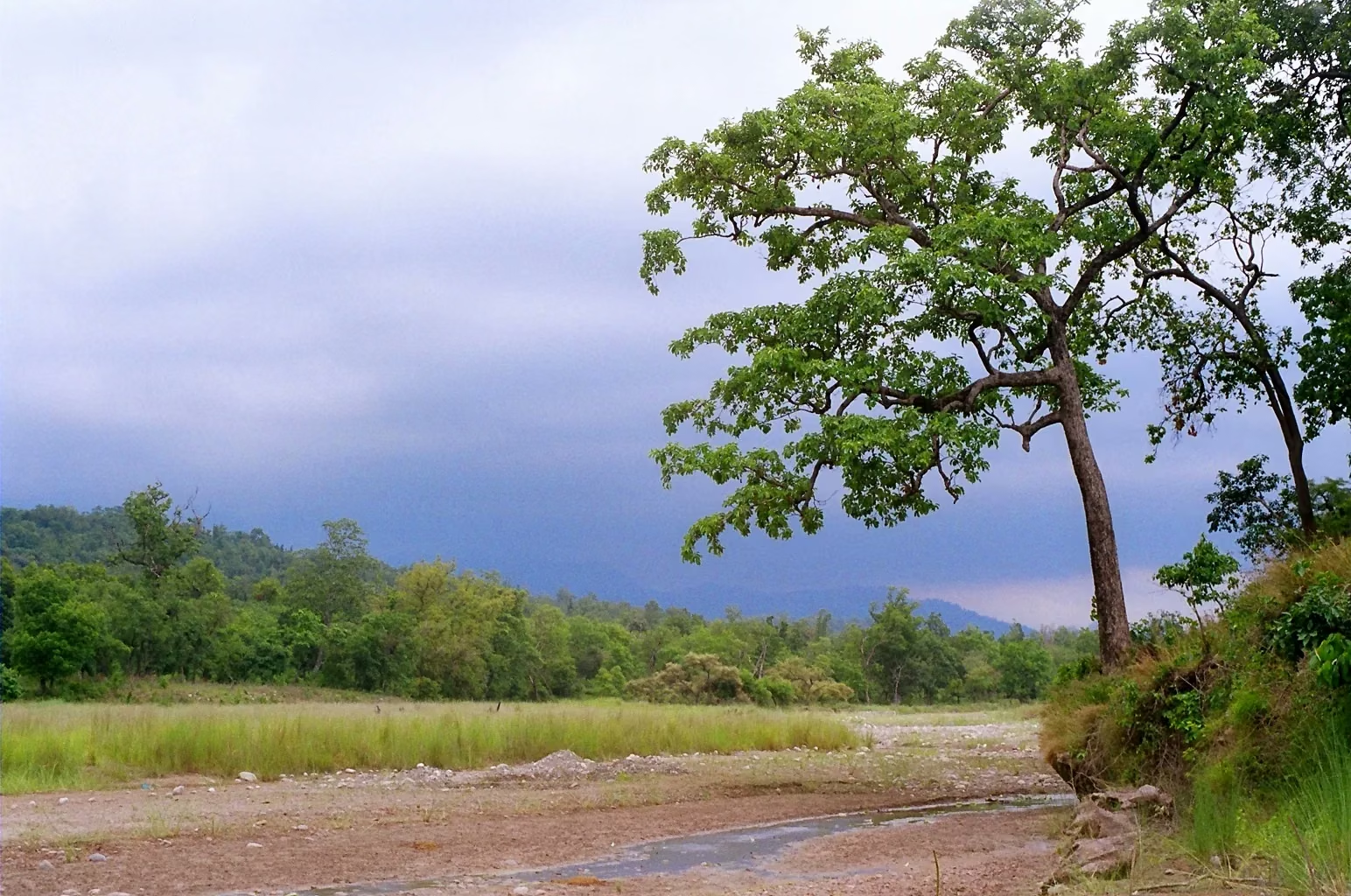
Riverbed sand and boulder extraction on the streams that run past the western and southern sides of Rajaji Tiger Reserve is a subject where confident statements travel faster than documents. This page is a record explainer, not legal advice and not a field report. It reads four dated public documents and keeps three distinctions visible throughout: a recommendation is not a clearance, a lot outside a protected-area boundary is not automatically outside an eco-sensitive zone, and a proposal that appears in a court or tribunal record is not evidence that anything is happening on the ground.
Sources used, all checked on 23 October 2026: the minutes of the 79th meeting of the Standing Committee of the National Board for Wild Life, held on 31 July 2024; the Supreme Court clarification of 28 April 2023 in the T.N. Godavarman matter, which quotes paragraph 65 of the judgment of 26 April 2023; the ministry's draft Rajaji eco-sensitive zone notification of 2018; and the Uttarakhand High Court judgment of 2 January 2023 in Writ Petition (PIL) No. 168 of 2019. Nothing drawn from any other tribunal or court matter is used here, and separate cases are not merged into one another.
What was before the committee in 2024
Three agenda items in the 79th minutes concern riverbed material near this reserve, all from Uttarakhand. Item 79.2.26 is proposal FP/UK/MIN/38285/2020 from the Uttarakhand Forest Development Corporation, for collection of minor minerals from Song 1, 2, 3 and Jakhan 1, 2 of the Dehradun Forest Division. Items 79.2.27 and 79.2.28 are two Windlass riverbed material mining proposals, FP/UK/MIN/5059/2020 over 9.878 hectares and FP/UK/MIN/5052/2020 over 13.161 hectares.
The minutes describe the corporation proposal as four mining lots within the default 10 km eco-sensitive zone of Rajaji Tiger Reserve, situated at different distances from the northern boundary of the western part of the reserve, and then print the lots: Song 1 at 8.5 km over 202 hectares, Song 2 at 5.1 km over 136.85 hectares, Song 3 at 0.2 km over 93.5 hectares, and Jakhan at 5.4 km over 96.5 hectares. The sentence introducing that list gives the range as 0.7 to 8.5 km, which does not match the 0.2 km printed for Song 3 in the same paragraph. Both are reported here as printed, because the mismatch is in the document and resolving it silently would be a small act of invention. The two Windlass proposals are described as lying at 1.1 km and 1.4 km from the reserve.
The history of the items is also in the minutes. The Windlass proposals were first discussed at the 67th meeting on 25 March 2022, when the committee asked the Wildlife Institute of India to prepare a holistic plan for critical animal passage in the landscape around the reserve, and deferred them. The institute later reported a 10 km radius landscape of 2,689 square kilometres around the reserve, of which about 1,662 square kilometres, roughly 74 per cent of the approximately 2,250 square kilometre holistic plan area, was delineated as critical zone, with the remainder treated as non-critical zone where proposals could be appraised subject to cumulative and site-specific study. Further deferrals followed at the 71st, 72nd, 73rd and 74th meetings, a meeting was convened on 9 October 2023, and the institute's report was submitted on 29 January 2024 before these proposals reached a decision.
The decision, and the one lot it rules out
The decision paragraph reads that, after discussions, the Standing Committee decided to recommend the proposals subject to conditions. The conditions are long and specific. For the corporation proposal they include replenishment studies for all rivers in the state before suitable mining areas are identified, annual updating and public uploading of district survey reports, restriction of mining to the central three-fourths of the river width with a minimum no-mining margin of 7.5 metres, a safety zone of not less than 200 metres near bridges, a 50-metre un-mined block after every 1,000 metres worked, no riverbed mining during the monsoon period, sunrise to sunset working only, no explosives or heavy machinery, no permanent structures, weighbridge and CCTV monitoring, third-party and public audits of extracted versus permitted quantity, and annual compliance certificates. One condition in that set is the bar on the closest lot: no mining shall be allowed in the Song-3 mining lot. A further condition bars any area the corporation has not identified in the comprehensive mining plan of the district.
For the two Windlass proposals the conditions add that extraction shall be exclusively manual, with no heavy machinery, drilling or blasting, no long-term dumping, no breaking of boulders or crushing within the lease site, no transport of extracted material on roads passing through the eco-sensitive zone or within the tiger reserve, no night-time mining or transport, and no labour camp within 1 km of the nearest forest boundary. The committee's own framing, recommendation subject to conditions, is a wildlife board recommendation. It is not the forest clearance, the auction, the lease or the environmental clearance that a working mine would require, and this article does not treat it as any of those.
Outside the boundary, and inside the zone, are two questions
The distances above are measured from the northern boundary of the western part of the reserve, which places the lots outside the protected area itself. The same paragraph describes those lots as within the default 10 km eco-sensitive zone. Both statements are in the document, and they are compatible, because being outside a national park or tiger reserve and being inside an eco-sensitive zone are different tests. This is the distinction most often lost in summaries: a lot can sit outside the reserve boundary and still fall within a zone in which specific activities are restricted or prohibited. Whether a particular zone applies to a particular lot, and how wide it is, is the next question, and it is where the Rajaji record gets unusual.
The Supreme Court directions of April 2023
The clarification of 28 April 2023 opens by quoting paragraph 65 of the judgment of 26 April 2023, which modified an earlier direction and stated that mining within a National Park and Wildlife Sanctuary, and within an area of one kilometre from the boundary of such park or sanctuary, shall not be permissible. The clarification records that this direction, previously associated with one state, was made applicable pan-India, and it explains why the question arose: in some protected areas the eco-sensitive zone is narrower than one kilometre, in some it is as little as 500 metres, and in some less.
It then addresses the part that matters for lots lying between 1 and 10 km from a boundary. The clarification states that any activity prohibited by the 2011 guidelines or by a specific eco-sensitive zone notification must be strictly followed; that since mining in an eco-sensitive zone is a prohibited activity, there is no question of such an activity being permitted in a zone even if it falls beyond one kilometre from the protected area boundary; that even where a zone extends more than one kilometre, mining proposed within it will not be permitted if it falls beyond one kilometre from the boundary; and that the one-kilometre prohibition travels beyond the zone only where the zone itself is less than one kilometre wide. In short, the one-kilometre rule sets a floor, not a ceiling, and the zone governs beyond it. This paragraph is a summary of what the orders say on their face, offered as an explainer, and it is not legal advice on any lot.
Rajaji's own zone: a draft from 2018, and a court record from 2023
The 2018 ministry document for this reserve is a draft. It was published in the Gazette Extraordinary of 22 May 2018 as S.O.2031(E), stating that it is the following draft of the notification which the Central Government proposes to issue, inviting objections and suggestions within sixty days from publication. Its extent clause provides that the eco-sensitive zone varies from zero, on account of the inter-state boundary, to 10 km around Rajaji National Park and Rajaji Tiger Reserve, with an area of 372.18 square kilometres. A draft is a proposal, and this article does not describe it as a notified zone.
The Uttarakhand High Court judgment of 2 January 2023, in a public interest petition concerning a stone crusher near Kotdwar, is used here for one point only: the state-side position it records. In the report of the Conservator of Forests, Shivalik Circle, placed before the court in that case, the reply on the first query was that the eco-sensitive zone of Rajaji National Park is yet to be notified, and that in cases where the eco-sensitive zone of a national park is not notified, areas within 10 km from the boundary are treated as eco-sensitive zone, so on that criterion the unit in that case lay within the zone. The 2024 minutes use the same formula, default 10 km ESZ. That case concerned a stone crusher and a licence, not the riverbed lots, and nothing from it is transplanted here beyond the recital of the zone status.
What the record leaves open
The public record read for this article does not resolve how the recommendation of 31 July 2024, framed in a default 10 km eco-sensitive zone, reconciles with the Supreme Court's April 2023 directions for areas within an applicable eco-sensitive zone. In the paragraphs of the minutes dealing with these three proposals, the April 2023 directions are not discussed, and the only kilometre-based condition attached to them is the prohibition on a labour camp within 1 km of the nearest forest boundary. Whether a later document addresses that question was not established here: this article draws only on the four sources listed at the top, and it cites no later meeting agenda or minute, because none was verified for this page.
Equally, the record does not show status. The minutes do not record a forest clearance, an environmental clearance, an auction, a lease in force or extraction at any of these lots, and nothing read for this article reports mining under way at them. Nothing here supports calling any lot illegal either: a standing committee recommendation with conditions is not a permit, and it is not a finding of violation. Both the claim that mining near the reserve is approved and the claim that it is unlawful go beyond what these documents say. If you need the current status of an individual lot, it has to come from the competent authority for that lot, not from a summary of a 2024 minute.
For the landscape these proposals sit in, our wildlife underpass article reads the camera-trap study of the crossings on the highways and railway lines, which is the linear infrastructure side of the same western landscape, and our rivers and waterholes guide covers the rivers, raus and seasonal water that riverbed mining is physically about. Those two pages are separate subjects and are linked separately on purpose. Our history and geography guide covers how the reserve took its present shape, and our myths and facts page covers why a recommendation is so easily quoted as an approval.
How to read the next headline about mining near Rajaji
Four questions cover most of what circulates. Which document, and is it minutes, a judgment, a draft notification or a licence. Which date, because a July 2024 recommendation is a July 2024 recommendation. Which lot, and is it inside the reserve, outside it, or inside a zone, because those are three different answers. And which step, since proposal, recommendation, clearance, auction, lease and extraction are six separate stages that summaries tend to collapse into one word. Asking them is the whole skill, and our how to verify an operator or a claim page covers the same discipline applied to safari bookings. For how numbers about wildlife in this landscape are produced, our research and monitoring article remains the reference.
Riverbed mining near Rajaji questions answered
What did the Standing Committee decide on 31 July 2024 about the Song and Jakhan lots?
The minutes of the 79th meeting record that the Standing Committee decided to recommend the proposals subject to conditions, and one of those conditions, specific to proposal FP/UK/MIN/38285/2020 of the Uttarakhand Forest Development Corporation, states that no mining shall be allowed in the Song-3 mining lot. The same condition list bars any area the corporation has not identified in the comprehensive mining plan of the district, requires replenishment studies, geo-tagged auction of lease areas, no riverbed mining during the monsoon period, sunrise to sunset working only, no explosives or heavy machinery, no permanent structures, monitoring infrastructure such as weighbridges and CCTV, and an annual compliance certificate. A recommendation subject to conditions is not a clearance, and this article does not describe any lot as approved.
What does the minutes document say about distances from the reserve boundary?
For the four corporation lots it describes them as within the default 10 km eco-sensitive zone of Rajaji Tiger Reserve and places them at different distances from the northern boundary of the western part of the reserve: Song 1 at 8.5 km over 202 hectares, Song 2 at 5.1 km over 136.85 hectares, Song 3 at 0.2 km over 93.5 hectares and Jakhan at 5.4 km over 96.5 hectares. The narrative sentence introducing that list instead gives a range of 0.7 to 8.5 km, which does not match the 0.2 km printed for Song 3 in the same paragraph. This article prints both figures and flags the mismatch rather than choosing silently between them. The two Windlass proposals are given at 1.1 km over 13.161 hectares and 1.4 km over 9.878 hectares from the reserve.
Does the Supreme Court allow mining just outside a reserve boundary?
The directions of 26 April 2023, as quoted in the clarification of 28 April 2023, state that mining within a National Park or Wildlife Sanctuary and within an area of one kilometre from the boundary of such park or sanctuary shall not be permissible, and the clarification records that this was applied pan-India. The clarification then addresses areas beyond one kilometre: it states that where a proposed mining area falls within an applicable eco-sensitive zone, the activity will not be permitted even if it is more than one kilometre from the protected area boundary, and that the one kilometre prohibition travels beyond the eco-sensitive zone only where that zone is itself narrower than one kilometre. This is a summary of what those orders say on their face and it is not legal advice.
Is the Rajaji eco-sensitive zone notified?
The 2018 document on the ministry website is a draft. It was published in the Gazette Extraordinary of 22 May 2018 as S.O.2031(E), inviting objections or suggestions within sixty days, and it describes a proposed eco-sensitive zone whose extent varies from zero, because of the inter-state boundary, to 10 km around Rajaji National Park and Rajaji Tiger Reserve, with an area of 372.18 square kilometres. The Uttarakhand High Court judgment of 2 January 2023 records, from a Conservator of Forests report placed before it, that the eco-sensitive zone of Rajaji National Park is yet to be notified and that where it is not notified, areas within 10 km of the boundary are treated as eco-sensitive zone. The 2024 minutes use the same expression, default 10 km ESZ.
Is mining happening now, and is any of it illegal?
This article answers neither question, because the public record read here does not settle either. The minutes of 31 July 2024 contain a recommendation with conditions and a bar on the Song-3 lot; they do not record a forest clearance, an auction, a lease in force or extraction at any of these lots, and nothing read for this article reports mining under way at them. Equally, nothing here supports calling any lot illegal: a recommendation is not a decision to permit, and the question of how the recommendation sits with the Supreme Court directions of 26 and 28 April 2023 for areas within an applicable eco-sensitive zone is not resolved in the portions of the record read for this page. Confirm the current status of any individual lot with the competent authority before relying on it.