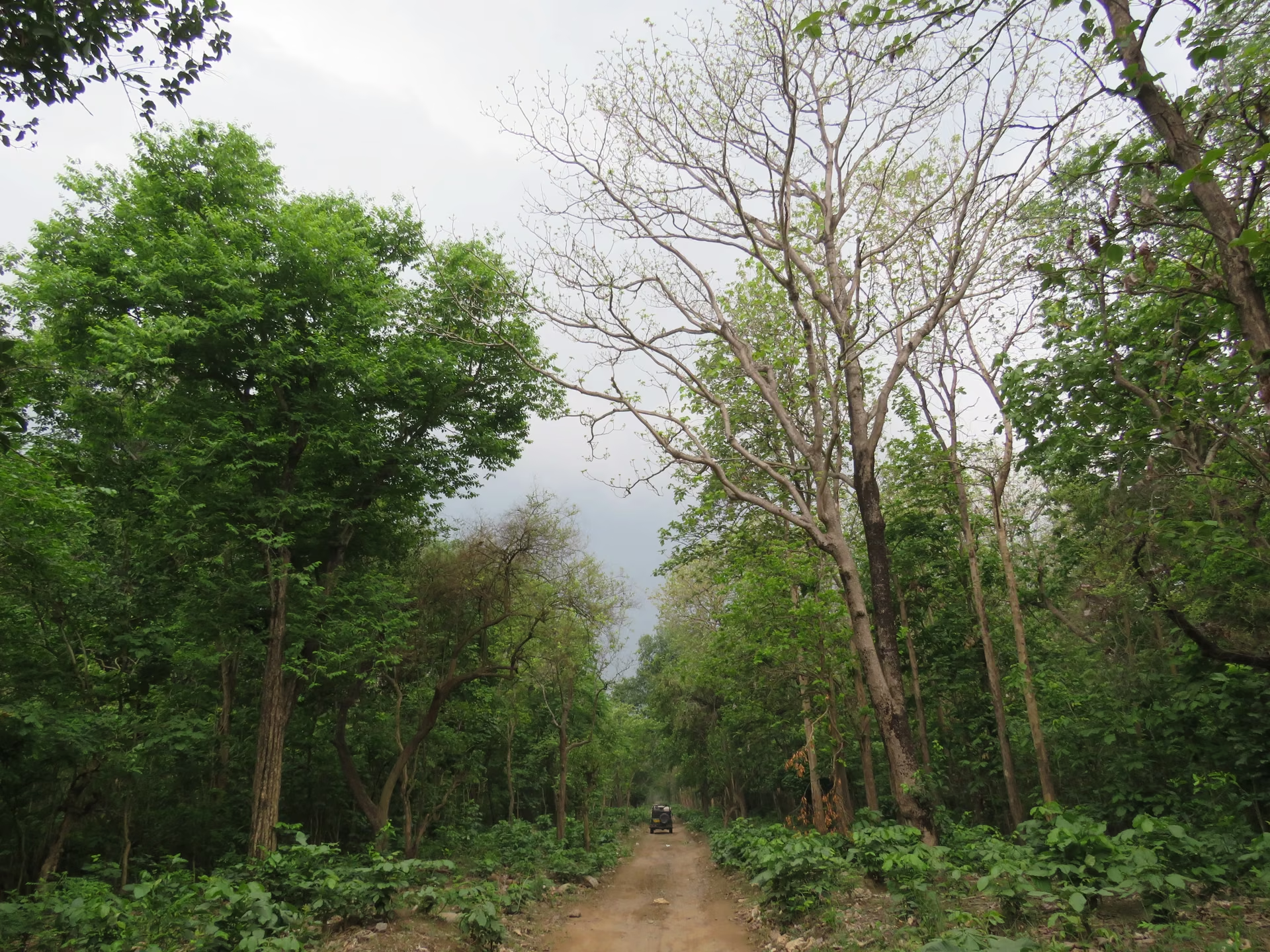
Roads, railways and built structures cross the western part of Rajaji Tiger Reserve, and every year travellers on the Haridwar and Dehradun routes drive past them without a second thought. What happens underneath, for animals, is a separate question, and it now has one peer-reviewed, open-access answer that is specific to this reserve. This article reads that single paper closely, keeps every number attached to its date and its method, and states plainly what the study does not show. It makes no claim about roadkill before and after, no claim about a recovered tiger or elephant population, and no claim that any structure here is an expressway.
Source used, checked on 22 October 2026: Verma, N., S. Badola & S. Mondol (2025). Evaluating wildlife activity and corridor functionality: a study of underpasses in and around Rajaji National Park, India. Journal of Threatened Taxa 17(4): 26780-26788, published 26 April 2025. The article page and the open-access PDF are both free to read. The authors are affiliated to the Forest Fire and Disaster Management unit of the Uttarakhand Forest Department in Dehradun, to Corbett Tiger Reserve at Ramnagar, and to the Wildlife Institute of India at Dehradun. The paper was received on 19 January 2025 and finally accepted on 3 April 2025.
Three underpasses, built in 2021, on three roads
The paper describes the Chilla-Motichur link as a 3-km long and 1-km wide stretch of forest connecting the Chilla range on the eastern side of the Ganga to the Motichur range on the west bank, and calls it the only functional link between the eastern and western parts of Rajaji National Park. It records that three wildlife underpasses, named Chilla-Motichur, Teenpani and Laltappar, were constructed on the highway in 2021, citing an earlier Wildlife Institute of India and Uttarakhand Forest Department report by Nigam and colleagues in 2022. The lengths it gives are 900 m for the Chilla-Motichur underpass and approximately 500 m each for Teenpani and Laltappar. The paper also notes that all three corridors are traversed by road, that underpasses are built on all three roads, and that the structures sit beneath flyover decks. Our ranges and map guide places those names on the landscape, and our gates and zones guide covers the visitor-side geography.
What the monitoring actually measured
Camera traps went out between April and November 2022. Sixty-four motion-triggered digital cameras of Cuddeback Model C1 were installed, yielding a total of 8,198 trap nights. Cameras were single-sided, mounted roughly 30 to 40 cm above ground level, and ran 24 hours a day. Beneath the flyovers they were placed at a minimum of 25 m and a maximum of 100 m from each other along the structure, so that an animal crossing above would not be missed. Twenty-four cameras covered the Chilla-Motichur corridor, and eight cameras each covered Teenpani and Laltappar. Eight adjacent forest beats across five ranges, inside Rajaji and inside the Dehradun Forest Division, were also sampled with three cameras per beat, except six cameras in the larger Chandi beat of Barkot Range. Cameras were checked fortnightly for battery status and data retrieval.
The paper gives per-site dates and effort. Laltappar ran from 12 April 2022 to 5 November 2022 with eight cameras and 1,656 trap nights across 500 m. Teenpani ran from 10 June 2022 to 5 November 2022 with eight cameras and 1,184 trap nights across 500 m. Chilla-Motichur ran from 25 April 2022 to 26 November 2022 with 24 cameras and 4,485 trap nights across 900 m. Photographs were identified manually by one observer and verified by a second, with a one-minute interval used to define independent capture events. If you want the general habit behind that discipline, our field notes guide covers how to record a sighting so that it stays useful.
What was recorded in the corridors
Over those 8,198 trap nights, 17 species were recorded in the connected forest areas and nine inside the corridors. Chilla-Motichur and Laltappar each recorded seven species, and Teenpani recorded six. The two most frequently captured species across the corridors were wild pig and sambar, and Teenpani carried the highest Relative Abundance Index values for both, at 227.2 and 123.31. Read as a table rather than as a headline, the corridor values look like this: sambar at 99.64 for Laltappar, 123.31 for Teenpani and 7.8 for Chilla-Motichur; wild pig at 13.89, 227.2 and 22.07; chital at 50.12, not recorded and 8.03; elephant at 19.93, 2.53 and 0.89; leopard at 12.08, 15.2 and 4.01. The adjacent forest areas carried higher values for almost every species, including chital at 1,363.44 and sambar at 993.55, and the authors report a Wilcoxon test with V = 0 and p below 0.001 for that difference.
Two rows in that table matter as much as the wildlife rows. Livestock were recorded at 397.34 for Laltappar, 333.61 for Teenpani and 108.58 for Chilla-Motichur. Humans were recorded at 752.42 for Laltappar, 26,094.59 for Teenpani and 2,360.98 for Chilla-Motichur, against 206.45 in the adjacent forest areas. A corridor is not a tunnel through empty forest, and those are the numbers that say so.
How behaviour shifted between corridor and forest
The authors compared activity patterns inside the corridors against the adjacent forest using overlap coefficients. Chital, the only diurnal species in the set, was active through the 24-hour cycle inside the corridors but showed a distinct early-morning peak in the forest, with an overlap of 0.68. Elephants flipped from a daytime peak in the forest ranges to a night-time peak in the corridors, at 0.48, which the authors read as avoiding human presence. Sambar avoided daytime in the corridors and peaked early in the morning, at 0.55. Wild pig kept its night-time peaks in both habitats, at 0.71. Human activity was exclusively daytime across all corridors and overlapped most with chital at 0.61. For the two species the authors flag as most often involved in negative human-wildlife interactions, the evening overlap with human activity was 0.25 for elephants and 0.39 for leopards. Our elephant sightings guide and our tracks and signs guide cover what that looks like from a vehicle.
The tiger result, which is the easiest to misread
Here is the sentence this article exists to protect. In the Relative Abundance Index table, tiger is shown with a dash for Laltappar, Teenpani and Chilla-Motichur, and with 4.3 in the adjacent forest areas. No tiger was recorded inside any of the three corridors during this study.
Separately, in the discussion, the paper reports that in 2022 a male tiger was photo-captured in camera traps moving from the Chilla Range in the east to the Motichur Range in the west, and the authors read that observation as a sign of restored historical connectivity between the eastern and western parts of the park. The paper does not state that this animal was recorded inside an underpass. It also records, citing press reporting and a personal communication dated 20 March 2025, that four tigers were translocated from Corbett Tiger Reserve to western Rajaji between 2021 and 2024. A movement record across a landscape and a detection inside a structure are different things, and this article will not merge them. For the wider sampling context behind tiger numbers at this reserve, our research and monitoring article covers the 2022 national estimation cycle, and our tiger sighting guide covers expectation management on a drive.
What a Relative Abundance Index is, and is not
The paper defines RAI as the number of independent detections per 1,000 trap nights, following a 2011 methodological framework on abundance, density and relative abundance in camera-trap studies. It is a rate of photographs, not a headcount. The authors say so themselves in the limitations: the study was constrained by a smaller sample size, by the absence of a more systematic sampling design, and by coverage of only limited areas around the flyovers; the analyses were therefore restricted to RAI as an indicator of site use intensity; and interpreting RAI as abundance may be incorrect, because the number of captures may be affected by habitat quality, disturbances, individual behaviour and camera placement. The same caution applies to the activity patterns, which the authors note can be affected by similar biases. That is the sentence to carry into any conversation where someone quotes a corridor number as though it were a count of animals.
What the authors report as still unfinished
The discussion names three obstacles, and all three are the authors own reporting rather than this article inference.
- The railway. The paper writes that although highway underpasses support wildlife movement, parallel railway lines may act as significant barriers, particularly for elephants, and that targeted mitigation is needed. In its recommendations it lists advance alert systems, improved braking systems in trains, regular patrolling and crossing infrastructure for railways.
- Debris, dumping and old roads. The paper reports that debris from underpass construction, garbage dumping, and the use of old roads below the flyover at Teenpani exacerbate habitat degradation. Its recommended active measures include habitat restoration to increase forest cover, restricting human activity during critical wildlife movement times, and ensuring proper disposal of construction debris and garbage.
- The ammunition depot. The authors write that the Chilla-Motichur corridor is yet to be fully restored because an existing ammunition depot of the Indian army cuts through it, leaving little space for unrestricted movement of wild animals, and they list shifting that depot among the active measures needed to fully restore the corridor.
None of those is a claim about what has happened since publication. The paper appeared on 26 April 2025, and this article checked the public record on 22 October 2026.
What this article deliberately does not claim
It does not claim that roadkill or rail strikes have fallen, because the study contains no before-and-after mortality dataset. It does not claim a recovered tiger or elephant population, because a corridor detection rate is not a population estimate, a point our myths and facts page makes about wildlife numbers generally. It does not describe these structures as an expressway, because the paper says highway. It does not claim that the underpasses are effective, because the authors present them as infrastructure whose utility depends on measures that are still outstanding. And it does not extend any finding to railways as though railways had been monitored here, since the railway barrier is raised by the authors as a concern drawn from other literature rather than as a result measured at Rajaji.
What this means on a drive
Very little changes at the gate. You still report to your zone, still follow the directions given by forest staff, and still have no guarantee of any sighting. What changes is the vocabulary. When a guide or a blog tells you that wildlife crossings at Rajaji are working, you can now ask which study, which year, which species, and whether the number being quoted is a detection rate. For the rest of the planning stack, our habitats and flora guide covers what grows where, our history and geography guide covers how the reserve came to be split by the river, and how to verify an operator or a claim covers the checking habit itself.
Rajaji wildlife underpass questions answered
Did any tiger use the three underpasses during the 2022 camera-trap study?
No tiger was recorded inside any of the three corridors in the study this article reads. In the paper table of Relative Abundance Index values, Tiger Panthera tigris is shown with a dash for Laltappar, Teenpani and Chilla-Motichur, and with 4.3 independent detections per 1,000 trap nights in the adjacent forest areas. Separately, the discussion reports that a male tiger was photo-captured in camera traps in 2022 moving from the Chilla Range in the east to the Motichur Range in the west. The paper presents that movement as a sign of restored connectivity across the wider corridor, and it does not state that the animal was recorded inside an underpass. The two statements are different, and this article keeps them apart.
How large were the underpasses, and when were they built?
The paper states that three wildlife underpasses, Chilla-Motichur, Teenpani and Laltappar, were constructed on the highway in 2021, citing Nigam and colleagues in 2022. It gives the Chilla-Motichur underpass a length of 900 m and describes the Teenpani and Laltappar underpasses as approximately 500 m each. The paper describes them as underpasses on a highway, and this article does not describe them as an expressway, does not say they are on a railway, and does not attach any construction cost to them.
How much effort went into the monitoring?
Camera traps were deployed between April and November 2022 using 64 motion-triggered Cuddeback Model C1 cameras that yielded 8,198 trap nights in total. Twenty-four cameras covered the Chilla-Motichur corridor, and eight cameras each covered Teenpani and Laltappar. Cameras were single-sided, mounted about 30 to 40 cm above ground level, and beneath the flyovers they were placed between 25 m and 100 m apart so that an animal crossing above would not be missed. Eight adjacent forest beats across five ranges were also sampled with three cameras per beat, except six cameras in the larger Chandi beat of Barkot Range. Cameras ran 24 hours and were checked fortnightly.
What does a Relative Abundance Index number actually mean?
In this paper RAI is defined as the number of independent detections per 1,000 trap nights, following a 2011 methodological framework on abundance, density and relative abundance. It is a rate of photographs at a site, not a count of animals. The authors are explicit about the limit: they write that the study was constrained by a smaller sample size, the absence of a more systematic sampling design, and coverage of only limited areas around the flyovers; that the analyses were therefore restricted to RAI as an indicator of site use intensity; and that interpreting RAI as abundance may be incorrect because the number of captures may be affected by habitat quality, disturbances, individual behaviour and camera placement.
What do the authors say is still blocking the corridor?
Three problems are named in the paper. First, the authors write that parallel railway lines may act as significant barriers, particularly for elephants, and recommend advance alert systems, improved braking systems in trains, regular patrolling and crossing infrastructure. Second, they report that debris from underpass construction, garbage dumping and the use of old roads below the flyover at Teenpani exacerbate habitat degradation. Third, they state that the Chilla-Motichur corridor is yet to be fully restored because an existing ammunition depot of the Indian army cuts through it, leaving little space for unrestricted movement of wild animals, and they list shifting that depot among the active measures needed.