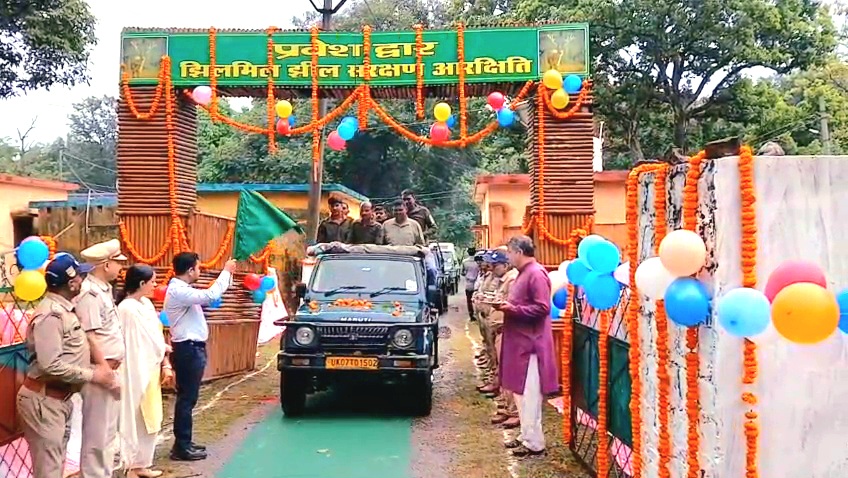
On 15 October 2026, ETV Bharat published a report from Haridwar saying that the gates of the Jhilmil Jheel Conservation Reserve, on the Haridwar-Laldhang route, had been opened for visitors and that jungle safari vehicles were sent off for the season. This article explains that report in English, keeps the source and its publication date visible, and separates what the news article actually states from what a visitor still has to confirm with the Forest Department before travelling.
Source of this explainer: the original ETV Bharat report in Hindi, published 15 October 2026 at 7:26 PM IST and credited to the ETV Bharat Uttarakhand Team. It is a regional news report, not a Forest Department notification, so nothing in it replaces current written instructions from the responsible office.
Photo: ETV Bharat — the report’s image of the Jhilmil Jheel Conservation Reserve gates opened for visitors on the Haridwar-Laldhang route.
What the report says happened on 15 October 2026
According to the report, the gates of the Jhilmil Jheel Conservation Reserve located on the Haridwar-Laldhang route were opened for tourists on Thursday, 15 October 2026. It states that Haridwar DFO Swapnil Anirudh performed the traditional worship and then flagged off the jungle safari vehicles with a green flag. The same report gives the visitor season as running from 15 October to 30 June, during which tourists can take the jungle safari.
The article also frames Jhilmil as an emerging visitor attraction alongside Rajaji Tiger Reserve and Jim Corbett Park, pointing to natural scenery and the presence of wildlife. That comparison describes growing visitor interest. It is not a statement that Jhilmil Jheel is a selectable zone inside the Rajaji Tiger Reserve booking system, and it should not be read as one. Keep the two separate when you plan, as explained further below.
How the report presents the DFO’s words
An important detail for readers who want an accurate quotation: the ETV Bharat article does not carry a single set of quotation marks around the DFO’s remarks. His explanation reaches the reader as reported speech, the standard Hindi news construction in which the article states that the official said or explained something, without reproducing his exact wording.
Because the source uses indirect speech, this explainer does not invent a verbatim quotation. Instead it offers an attributed translated paraphrase, deliberately presented without quotation marks:
Attributed paraphrase, translated from the Hindi report and not a verbatim quotation: Haridwar DFO Swapnil Anirudh is reported as saying that the Jhilmil Jheel gates are closed on 30 June because of the monsoon, keeping visitor safety and wildlife conservation in mind, and that the gates are reopened again on 15 October.
He is further reported as saying that visitors can see wildlife such as elephant, leopard and bear at the site, that the Forest Department has made elaborate safety arrangements, and that any visitor can register offline and go on the jungle safari. If you need his precise words for any official purpose, ask the Haridwar Forest Division or read the original Hindi report; do not treat the paraphrase above as a transcript.
Offline registration: what the report states and what it leaves out
The report’s registration point is simple: it says a visitor can complete offline registration and then go on the jungle safari, and that the Forest Department has put safety arrangements in place. That is a useful, concrete detail for anyone standing in Haridwar and asking how access works this season.
What the article does not contain matters just as much. It publishes no entry fee, no online booking route, no daily reporting time, no safari duration, no phone number, no list of rules, and no gate location beyond describing the gates as being on the Haridwar-Laldhang route. This explainer does not supply any of those missing details, because inventing them would be worse than not having them. Every one of them must come from the responsible office in current, written form.
Wildlife mentioned in the report, with no guarantees attached
The report lists elephant, leopard, bear, chital, deer and sambar among the wildlife visitors may get a chance to see in their natural habitat in the Conservation Reserve, and it also notes that tigers are sometimes seen there. It describes woodland and grassland scenery as part of the experience.
None of that is a promise. Animals are free-ranging, and a news summary of a protected area is not a sighting forecast for any particular morning or afternoon. No guide, operator or article can guarantee that a particular species will appear at a particular point. Read the list as background on what the area holds, then keep expectations realistic and follow the instructions of forest staff on the ground.
Why Jhilmil may still be missing from the Rajaji booking pages
A separate check shows why visitors can be confused. The Rajaji Tiger Reserve homepage and day-visit booking page, as reviewed on 16 October 2026, did not list Jhilmil as a selectable safari zone and did not publish a Jhilmil-specific tariff or timing. Those pages describe what that portal currently offers.
The two facts sit side by side without cancelling each other. ETV Bharat reports that the local Jhilmil gates opened for the season and that registration is possible offline; the silence of one portal neither withdraws that report nor proves that a local service is absent. The portal’s list is evidence about the portal only. Equally, the news report is not a tariff sheet: it does not authorise a fee assumption. Do not copy a Chilla, Motichur or other zone price or timetable onto a Jhilmil plan, and do not treat a missing name on a website as either a closure notice or a booking confirmation.
For the longer discussion of what official listings do and do not confirm, see our Jhilmil safari and official zone listings guide. Read together with this dated report, it shows the picture clearly: the portal pages checked on 16 October 2026 remained without a Jhilmil option, while the 15 October 2026 news report describes separate local gates opening with offline registration. Both statements are current, and neither one replaces the other.
What the Wildlife Institute of India page adds
Background on the place itself comes from a different kind of source. The Wildlife Institute of India profile for Jhilmil Jheel Conservation Reserve describes a Conservation Reserve of 37.83 square kilometres on the left bank of the Ganga, in the Chiriyapur forest range of Haridwar district.
That page carries a clear age marker: the profile was last updated on 22 November 2016. It is ecological and geographical information about a protected area, not an operational notice about gates, dates, registration or fees. Use it to understand what Jhilmil is, and use current Forest Department communication for the separate question of how a visit is arranged this season.
What to confirm before you travel
For current dates, the registration point, the applicable fee, daily timings and vehicle availability, contact the responsible Haridwar Forest Division or the Forest Department directly, and rely only on current written confirmation. Ask for the reply in a form you can keep, such as an email, an official message or a signed receipt, and check that it names Jhilmil Jheel rather than another forest division’s attraction.
The official Rajaji Tiger Reserve contact page is a reasonable starting point if you need help identifying which office to ask, since it publishes contact details for the reserve. It is offered here only as a possible first call: nothing on that page, and nothing in this article, establishes that Rajaji Tiger Reserve manages the Jhilmil Jheel gates or its registration process.
- Ask which office is responsible for Jhilmil Jheel access this season, and record that office’s name.
- Request the exact registration point on the Haridwar-Laldhang route, with written confirmation.
- Ask for the current fee, the reporting time and whether vehicles are available on your date.
- Recheck shortly before travel, since dates and arrangements can change after a news report is published.
- Carry the written confirmation with you and expect forest staff instructions at the site.
How this report updates our Jhilmil coverage
Our earlier guide, Jhilmil Safari and Rajaji National Park: What Official Listings Confirm, is clearly updated by this dated reporting: that page set out what the official portal pages showed when they were checked on 16 October 2026, and it did not include a Jhilmil option, tariff or timing. This article adds what ETV Bharat published on 15 October 2026 about the local gates opening on the Haridwar-Laldhang route and offline registration being available to visitors.
The earlier guide keeps its point: the Rajaji portal pages reviewed there do not list Jhilmil as a selectable zone. This page keeps its point: a news report describes separate local gates opening with offline registration. Read both with their dates attached, keep the portal list and the local reopening distinct, and take the operational detail from the responsible office rather than from either summary.
Wildlife watching in the wider landscape is covered separately in our Jhilmil Jheel Conservation Reserve facts guide and the barasingha and wetland habitat guide. Those pages describe the reserve; this page carries the dated visitor news and should be the one you reread when checking whether the gates are open.
Jhilmil Jheel 2026 questions answered
When did the Jhilmil Jheel safari gates open, and what season does the report describe?
ETV Bharat reported that the gates of the Jhilmil Jheel Conservation Reserve on the Haridwar-Laldhang route were opened for visitors on 15 October 2026, and that tourists can take the jungle safari from 15 October to 30 June. Treat both dates as the news report’s account of the season and confirm them with the responsible Haridwar Forest Division before travelling.
Did ETV Bharat publish a direct quotation from the Haridwar DFO?
No. The Hindi report presents the DFO’s remarks as reported speech rather than a verbatim quotation, so this article does not place his words in quotation marks. It gives an attributed translated paraphrase instead: Haridwar DFO Swapnil Anirudh is reported as saying that the Jhilmil Jheel gates are closed on 30 June because of the monsoon, keeping safety and wildlife conservation in mind, and are reopened on 15 October.
Does the report mean visitors can register offline for the Jhilmil safari?
The ETV Bharat report states that the Forest Department has made safety arrangements and that any visitor can register offline and go on the jungle safari. It does not publish a fee, an online booking route, a registration counter location, daily timings, a safari duration or a phone number, so the registration point and current fee must be confirmed with the responsible Haridwar Forest Division.
Why does Jhilmil not appear on the Rajaji Tiger Reserve booking pages?
The Rajaji Tiger Reserve homepage and day-visit booking page checked on 16 October 2026 did not list Jhilmil as a selectable zone and did not publish a Jhilmil tariff or timing. That absence describes only those portal pages: it neither cancels the ETV Bharat report of separate local gates opening with offline registration nor proves that no local service exists. Ask the responsible Forest Division for current written confirmation.
Which animals does the report mention at Jhilmil Jheel, and are sightings guaranteed?
The report mentions elephant, leopard, bear, chital, deer and sambar in the Conservation Reserve, and also notes that tigers are sometimes seen there. Nothing in it guarantees an encounter: animals move freely, so treat the list as a description of wildlife recorded in the area rather than a promise of what any single visit will show.