Living Beside a Tiger Reserve
Rajaji National Park does not exist in isolation. It sits within a landscape that includes villages, settlements, farmland and communities whose daily lives unfold alongside — and sometimes in direct contact with — the park's wildlife. Understanding this human dimension is essential for any visitor who wants to engage with Rajaji beyond the safari jeep. Conservation in India is not just about protecting animals in a park. It is about managing a shared landscape where human needs and wildlife needs overlap, compete and — with effort — find ways to coexist.
The communities living near Rajaji's buffer zones and fringes have a relationship with the forest that predates the park's formal establishment. They know the seasonal rhythms of elephant movement, the areas where wild boar raid crops and the times of year when predators bring livestock losses. This lived knowledge is an important part of the conservation picture, even if it is not always visible to the visiting tourist.
This guide covers what it means to live beside a tiger reserve: the realities of human-wildlife interaction, the challenges communities face, the mitigation efforts in place, the role of wildlife corridors and what responsible visitors can do to support coexistence.
The Realities of Human-Wildlife Interaction
Living near a national park that harbours elephants, tigers, leopards and bears is not a romantic proposition — it is a daily negotiation between human livelihoods and animal behaviour. The challenges are real, recurring and often underappreciated by visitors who see the park only from the safari vehicle.
Crop raiding
Elephants, wild boar and sometimes deer move out of the park and into adjacent farmland, particularly during seasons when food is scarce inside the forest or when crops in nearby fields are at their most attractive stage of growth. For farmers, a single night of elephant activity can destroy a significant portion of a season's crop. Wild boar damage is more persistent and widespread — these animals root through fields repeatedly, damaging root crops, cereals and young plantings. Crop raiding is one of the most common and economically significant forms of human-wildlife interaction in India's tiger reserve buffer zones.
Elephant movement through settled areas
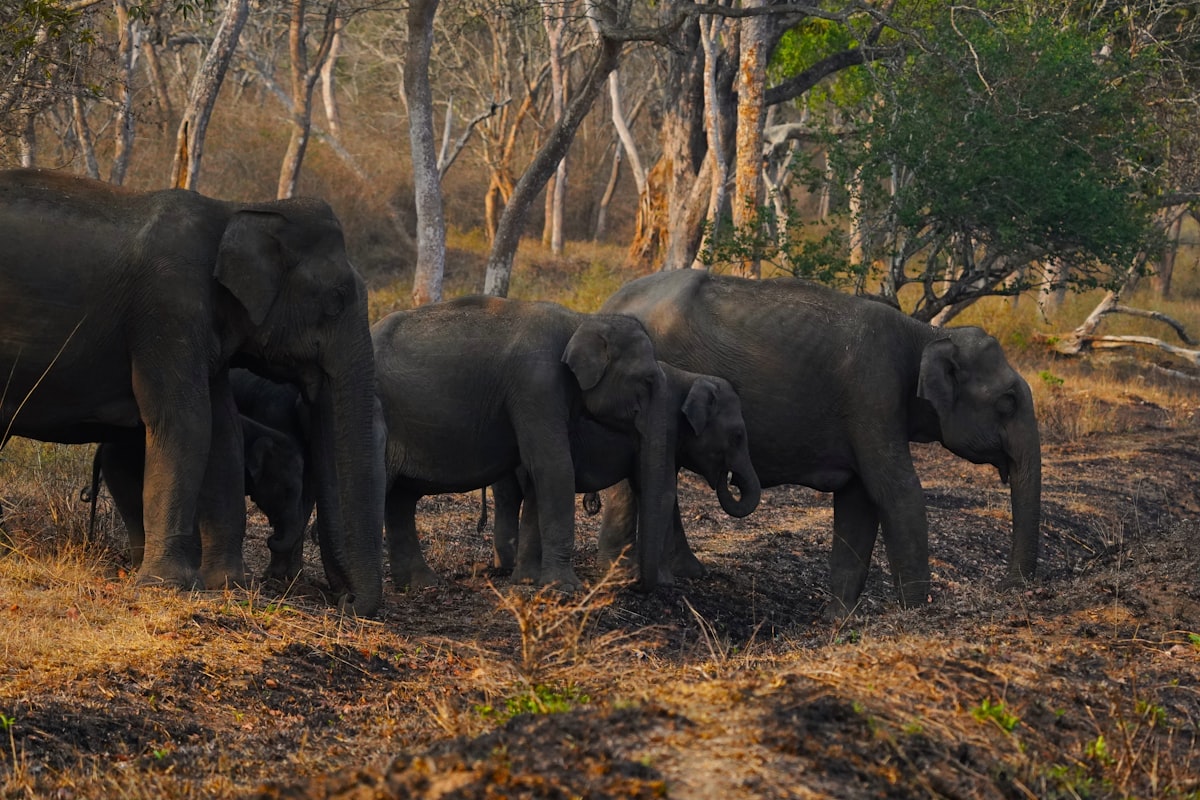
Asian elephants are wide-ranging animals that do not recognise park boundaries. Herds move through corridors that pass near or through villages, particularly during seasonal transitions. Elephant movement near settlements creates safety concerns — elephants are large, powerful animals that can be dangerous when surprised, threatened or in musth (a periodic hormonal state in bulls that increases aggression). Communities living along elephant corridors develop awareness of movement patterns and adjust their routines accordingly, but the risk is never entirely eliminated.
Livestock safety
Villages near the park keep livestock — cattle, goats, buffalo — that graze on forest edges and common land adjacent to the park. Tigers, leopards and occasionally bears may prey on livestock that stray into or near the forest. A livestock loss represents a significant economic blow to a family whose livelihood depends on the animal. The balance between allowing livestock grazing near forest areas (a traditional practice) and protecting those animals from predators is an ongoing challenge.
Snakebite and smaller wildlife encounters
Communities near the forest also contend with more frequent but less dramatic wildlife encounters — venomous snakebite, porcupine damage to stored grain, civet or rat damage to food supplies and the general discomfort of sharing living space with wildlife that does not recognise human property boundaries. These everyday interactions shape the community's relationship with the forest in ways that a safari visitor may never see.
How Communities and the Forest Department Work on Mitigation
Managing human-wildlife coexistence requires coordinated effort between the communities who live in the landscape, the Forest Department that manages the park, and various support organisations that provide resources and expertise. While the specific programmes and schemes evolve over time, the general categories of mitigation work include:
Early warning and awareness
Communities near elephant corridors and predator territories develop awareness of animal movement patterns — seasonal routes, daily rhythms and the signs that indicate wildlife is passing through the area. This knowledge, built over generations and supplemented by Forest Department communication, helps people adjust their activities — avoiding certain areas at dawn and dusk, securing livestock in enclosures at night, storing grain in ways that reduce wildlife access. Awareness campaigns help communities understand animal behaviour and reduce the risk of dangerous encounters.
Physical mitigation measures
Various physical measures help reduce conflict at the boundary between human settlements and the forest. These may include solar-powered fencing around high-value crops in conflict-prone areas, reinforced livestock enclosures, early-warning systems using community-based monitoring and infrastructure designed to guide elephant movement away from settlements. The effectiveness of these measures depends on maintenance, community participation and the specific wildlife dynamics of the area.
Compensation and support systems
When crop or livestock losses occur, compensation mechanisms exist to partially offset the economic impact on affected families. These systems are administered through government processes and their availability, speed and adequacy vary. For communities that depend on agriculture and livestock for their livelihood, the gap between the loss and the compensation can be significant. Supporting these systems — through advocacy, awareness and direct engagement — is part of the broader conservation picture.
Community participation in conservation
Increasingly, conservation efforts near Rajaji recognise that community participation is not optional — it is essential. When communities have a stake in the park's conservation success — through employment as guides, trackers or eco-tourism staff; through access to sustainable livelihood alternatives; through voice in management decisions — the relationship between people and wildlife shifts from conflict toward coexistence. This is an ongoing process with real challenges, but the direction is toward partnership rather than exclusion.
The Role of Wildlife Corridors
Rajaji's conservation significance extends beyond its own boundaries. The park is part of a larger Shivalik landscape that includes other protected areas, forest blocks and connecting corridors. These corridors — strips of forest and semi-forested land that link one habitat area to another — are essential for the long-term survival of wide-ranging species like elephants and tigers.
Why corridors matter
- Genetic diversity: Corridors allow animals to move between populations, which maintains genetic diversity and reduces the risks of isolated, inbred populations.
- Range and resource access: Elephants and tigers require large areas to find food, water and mates. Corridors provide the connectivity that makes these landscape-scale movements possible.
- Conflict reduction: When animals have functional corridors that allow them to move between habitat areas without passing through settled land, human-wildlife conflict can be reduced. Corridors give wildlife space to move without encountering villages and farms.
- Climate adaptation: As climate conditions shift, corridors allow species to move toward more suitable habitat. Landscape connectivity is a key component of climate resilience for wildlife populations.
Rajaji's position in the corridor network
Rajaji sits within a corridor network that connects the Shivalik forest landscape across state boundaries. Elephants move between Rajaji and neighbouring forest areas, using corridors that pass through a mix of forest, scrub and human-modified landscape. Tigers range across landscape scales that exceed individual park boundaries. Maintaining the functionality of these corridors — ensuring that they remain forested, passable and not fragmented by development — is a conservation priority that extends beyond the park's own management.
What corridors mean for visitors
For visitors, corridors explain something important about the wildlife you see on safari. The elephants along the Ganga may have walked from a neighbouring forest block. The tiger whose pugmarks appear on the track may range across a territory that spans multiple administrative areas. Rajaji's wildlife is part of a connected landscape, and the park's boundaries are ecological permeable, not impermeable walls. Understanding this deepens your appreciation of what you are observing.
What Responsible Tourism Can Do
Tourism in and around Rajaji generates economic activity that can support — or undermine — conservation and community coexistence. The choices visitors make, from how they book their safari to how they behave in the park and near settlements, have real consequences.
Supporting local livelihoods
Choosing locally owned accommodation, hiring local guides and purchasing local products directs tourism revenue into the communities that live alongside the park. When communities benefit from tourism, the economic equation of coexistence shifts — wildlife becomes an asset rather than a cost. This does not solve all conflict, but it creates incentives for conservation that complement formal protection efforts.
Following wildlife etiquette
Responsible safari conduct — staying in the vehicle, maintaining noise discipline, not feeding wildlife, not littering, respecting speed limits near settlements — is not just about your own safety. It reduces the disturbance that safari vehicles cause to wildlife and to the communities living near the park. The wildlife etiquette guide covers the full framework of respectful conduct.
Being a thoughtful visitor near settlements
Driving through or near villages on the way to the safari gate is an opportunity to be a respectful visitor, not a sightseer. Drive slowly. Do not photograph people or their homes without permission. Recognise that the village you pass through is someone's home, not a tourist attraction. The communities near Rajaji are not there for your entertainment — they are there because they live there, and their cooperation with conservation depends on feeling respected by the visitors who pass through their landscape.
Sharing accurate information
What you share online about Rajaji — photographs, descriptions, recommendations — shapes how other visitors perceive and approach the park. Sharing information about responsible conduct, realistic wildlife expectations and respect for communities contributes to a tourism culture that supports conservation. Sharing sensationalised or inaccurate content — fabricated animal counts, exaggerated sighting claims or irresponsible behaviour as adventure — undermines that culture.
A Respectful-Visitor Checklist
Use this checklist to ensure your visit supports conservation and community coexistence:
Before you go
- Choose locally owned operators: Book accommodation, guides and transport that employ local people and direct revenue into the community. The budget planner covers cost components — look for options that support local livelihoods within your budget.
- Understand the landscape: Read about Rajaji's geography, habitats and wildlife before your visit. The history and geography guide and the habitats and flora guide provide essential context.
- Set realistic expectations: Understand that wildlife sightings are unpredictable, that communities near the park live with real challenges and that your role is to observe respectfully, not to demand a particular experience.
- Learn the etiquette rules: Review the wildlife etiquette guide before your trip so that the rules are familiar before you enter the park.
During your visit
- Drive slowly near settlements: Especially at dawn and dusk when wildlife is most active and people are moving between homes and fields. The safari access guide covers approach routes.
- Do not photograph people without permission: Treat village residents as you would want to be treated in your own neighbourhood.
- Follow all park rules: Stay in the vehicle, maintain noise discipline, do not litter, do not feed wildlife. These rules protect you, the wildlife and the park's relationship with neighbouring communities.
- Listen to your guide: The guide understands both the wildlife and the human landscape. Their instructions on driving, noise and conduct are informed by this dual knowledge.
- Respect closures and restrictions: If a road is closed, a zone is restricted or an area is off-limits, the reason may relate to wildlife movement, community safety or conservation needs. Accept the restriction without complaint.
After you leave
- Share responsibly: Post photographs and descriptions that reflect respectful, accurate engagement with the park and its communities.
- Recommend responsible operators: If you had a good experience with a locally owned operator, guide or accommodation, share that recommendation with other travellers.
- Consider ongoing support: If you want to contribute to conservation beyond your visit, look for reputable organisations working on wildlife corridor protection, community livelihoods or human-wildlife coexistence in the Shivalik landscape.
- Return with awareness: If you visit Rajaji again, bring the knowledge from your first visit. Each trip deepens your understanding of the landscape and your ability to engage with it respectfully.
Coexistence Is Not Perfect — and That Is Honest
It would be misleading to suggest that human-wildlife coexistence near Rajaji is seamless. It is not. There are real losses — crops destroyed, livestock killed, property damaged, lives disrupted. There are real tensions — between development and conservation, between traditional practices and modern wildlife management, between the economic needs of communities and the ecological needs of elephants and tigers. These tensions are not resolved by slogans or good intentions — they require sustained, practical work by the Forest Department, communities, conservation organisations and the visitors who enter this landscape.
What visitors can do is engage honestly. Acknowledge that your safari takes place in a landscape where other people live and work. Respect the rules that protect both wildlife and communities. Support the economic activities that give communities a stake in conservation. And recognise that the elephants, tigers and other wildlife you see on safari are not just tourist attractions — they are neighbours of the people who live at the park's edge, and the quality of that neighbourly relationship determines the long-term future of both the wildlife and the communities.
The conservation and elephants guide covers broader conservation context. The wildlife etiquette guide provides the practical framework for respectful visitor conduct. Together, they offer a foundation for engaging with Rajaji not just as a destination, but as a living landscape where conservation and community are inseparable.