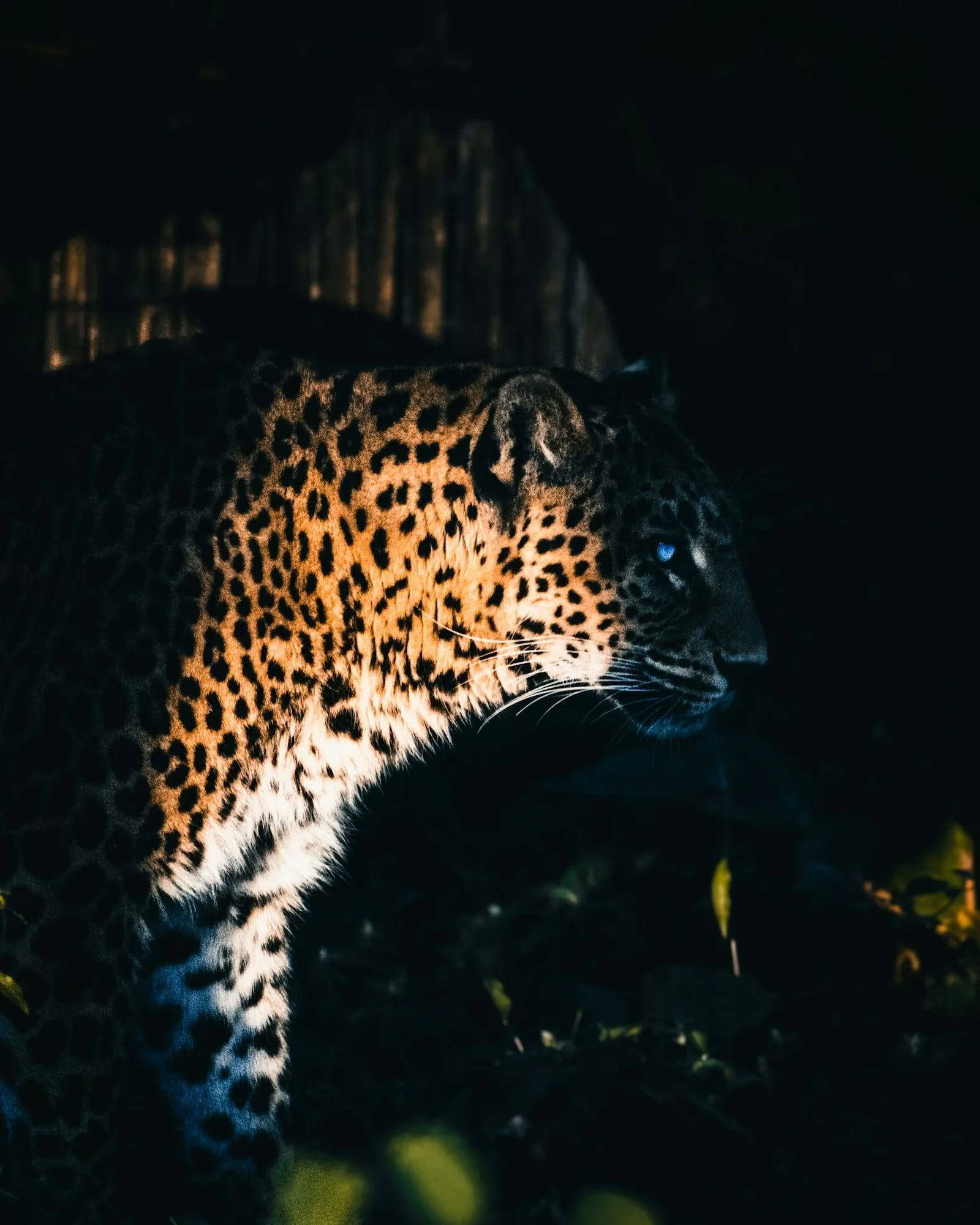
Beyond the Headlines: Rajaji's Full Wildlife Spectrum
Most visitors to Rajaji National Park arrive with their attention fixed on elephants and tigers — the park's most famous residents. And understandably so: Asian elephants are regularly seen along river corridors, and Rajaji's status as a tiger reserve confirms the presence of these iconic cats. But Rajaji's wildlife portfolio extends far beyond these headline species. The forest, grasslands, river habitats and hill terrain support a rich community of lesser-known mammals, reptiles and birds that reward the attentive visitor.
Among the most fascinating — and most elusive — are leopards and sloth bears. Both species inhabit Rajaji's Shivalik terrain, but neither is commonly seen on a typical safari. Understanding their ecology, recognising their signs and appreciating their role in the ecosystem transforms a sighting-focused mindset into a more rewarding engagement with the park. This guide covers leopards, sloth bears and the overlooked species that complete Rajaji's wildlife picture.
Leopards in Rajaji: Ecology and Behaviour
The leopard (Panthera pardus) is the most adaptable of India's big cats, and Rajaji's landscape — a mosaic of dense Sal forest, mixed deciduous woodland, riverine scrub and rocky hill terrain — provides excellent leopard habitat. Leopards thrive in the Shivalik foothills because the terrain offers cover, prey and elevation changes that suit their solitary, territorial nature.
Why leopards are rarely seen
Leopards are crepuscular and nocturnal by preference, most active during dawn, dusk and nighttime hours. During a standard daytime safari, a leopard is typically resting in dense cover — under thickets, in rocky overhangs, within dense Sal undergrowth or on elevated terrain with good visibility. Their spotted coat provides exceptional camouflage against the dappled light of the Shivalik forest. Even when a leopard is nearby, it may be invisible to untrained eyes.
The leopard's behaviour around vehicles also reduces encounter frequency. Unlike elephants, which are habituated to vehicle presence along popular routes, leopards tend to move away from human activity. A leopard that hears a jeep approaching will typically retreat into deeper cover rather than remain visible. This means that most leopard encounters are brief — a flash of spotted coat crossing the track, a tail disappearing into the undergrowth, a face glimpsed through a gap in the vegetation.
What influences leopard visibility
- Cover density: In months when vegetation is thick (post-monsoon, early winter), leopards have more hiding options and are less visible. As vegetation thins in the dry season (March to June), limited cover can occasionally push leopards into more open terrain — but this is not a reliable pattern.
- Prey availability: Leopards follow their prey. Areas with healthy deer populations may support territorial leopards, but the predator's range is large enough that prey presence in one area does not guarantee a leopard is nearby at any given time.
- Territorial movement: Male leopards patrol large territories, sometimes overlapping with tiger ranges. Their movement is not predictable on a safari-by-safari basis.
- Zone terrain: Zones with more rocky outcrops, hill terrain and dense scrub may offer better leopard habitat than flat, open grassland zones — but no zone is a "leopard zone" in the sense of reliable sightings.
The honest expectation: most visitors will not see a leopard on a single safari. What you may encounter is evidence of their presence — and that evidence is rich and fascinating in its own right.
Sloth Bears: Rajaji's Shaggy Forest Dwellers
The sloth bear (Melursus ursinus) is a Shivalik specialty — these bears are found in the dry and moist forests of the Indian subcontinent, and the Shivalik foothills represent core sloth bear habitat. Rajaji supports a resident sloth bear population, though — like leopards — they are rarely seen in the open.
Sloth bear ecology in Rajaji
Sloth bears are omnivorous, feeding on termites, ants, fruits, flowers and honey. Their long, curved claws are adapted for tearing open termite mounds and stripping bark from trees — activities that leave distinctive signs in the forest. They are primarily nocturnal and crepuscular, resting in dense cover during the day and emerging to forage in the evening and at night.
In Rajaji's terrain, sloth bears use a mix of dense forest, rocky areas and scrubland. They are solitary animals except for mothers with cubs, and their home ranges overlap with those of leopards and tigers — a coexistence managed through temporal separation (different activity times) and habitat preferences.
Signs of sloth bear presence
- Termite mound damage: Sloth bears tear open termite mounds with their claws, leaving distinctive claw marks and broken earth around the mound base. Fresh damage — loose soil, exposed tunnels — indicates recent activity.
- Tree bark stripping: Bears strip bark to access insects and sap beneath. Look for vertical claw marks on tree trunks, particularly on soft-barked species.
- Droppings: Sloth bear scat contains insect remains, fruit seeds and fibrous plant material. Fresh scat on the track is a strong indicator of recent bear movement.
- Footprints: Sloth bear pugmarks are large, with five toes and long claw impressions. Unlike leopard pugmarks (which are rounder with four toes and no claw marks, as cats retract their claws), bear tracks show claw marks clearly. The tracks and signs guide explains how to distinguish between different animal tracks.
Your guide can identify these signs as you drive. Learning to recognise them yourself adds a layer of engagement to the safari — even without a direct sighting, the evidence of a bear's passage through the forest is compelling.
Reading Signs Without Touching or Disturbing
The impulse to examine wildlife signs up close is natural, but it must be managed within safari conduct rules:
- Stay in the vehicle: Never leave the jeep to examine pugmarks, scat, scratches or termite damage. The forest floor is the territory of the animals you are observing — entering it uninvited is both unsafe and disruptive.
- Photograph from the vehicle: Use your camera or phone to capture signs visible from the jeep. Angled shots of pugmarks on the track, scratch marks on trees beside the road and termite mound damage within view are all possible without leaving the vehicle.
- Ask the guide to stop briefly: A brief stop for photography is different from wandering off the track. Your guide will judge whether a stop is safe and appropriate. If the guide says no, accept the decision — they may be aware of animal presence you cannot detect.
- Note the location: In your field notes, record the type of sign, the approximate location and the time. This builds a personal reference and helps the guide understand what you are interested in seeing.
- Do not collect or disturb: Never pick up scat, move bones, touch scratch marks or disturb termite mounds. These are part of the living forest — observe them as you would observe any wildlife.
The wildlife etiquette guide covers the full set of conduct rules. The principle is simple: observe without interfering.
The Role of Alarm Calls: When the Forest Warns
One of the most evocative experiences on a Rajaji safari is hearing alarm calls — sudden, urgent vocalisations from langur monkeys or spotted deer that signal a predator is nearby. Understanding these calls adds a dramatic dimension to the safari, even when the predator itself remains hidden.
Langur alarm calls
Langur monkeys are highly vigilant. When they detect a predator — leopard, tiger or sometimes even a large python — they produce loud, distinctive alarm calls from the canopy. These calls carry through the forest and are often the first indication that a predator is moving through the area. Your guide will listen for these calls and may redirect the vehicle toward the source, hoping to catch a glimpse of the predator before it retreats into cover.
Deer alarm calls
Spotted deer produce a sharp, barking alarm call when they detect danger. A single deer barking can indicate unease; a chorus of barking from multiple deer indicates active alarm. The direction and intensity of the calls help the guide estimate where the predator might be. Deer alarm calls are also triggered by human presence, vehicle noise and other non-predatory disturbances — so the guide interprets them in context, not in isolation.
What alarm calls mean for your safari
- Stay alert: When the guide signals that alarm calls are audible, reduce noise, scan the forest and be ready for a brief, intense sighting.
- Manage expectations: Alarm calls indicate predator presence, not predator visibility. The predator may be 200 metres away in dense cover, invisible despite the vocal warnings.
- Appreciate the ecosystem: Alarm calls are the forest's communication network in action. Hearing them connects you to the predator-prey dynamics that shape this landscape daily.
Overlooked Species: The Wildlife Most Visitors Miss
Beyond elephants, tigers, leopards and bears, Rajaji supports a range of species that are less famous but ecologically significant and rewarding to observe:
Jungle cat
The jungle cat (Felis chaus) is a medium-sized wild cat found in Rajaji's scrubland, grassland edges and riverine areas. It is more commonly heard than seen — its calls echo through the forest at dusk. Jungle cats are diurnal to crepuscular, and an alert guide may spot one crossing the track or sitting in low vegetation. They are not dangerous to humans and are generally tolerant of vehicle presence at a distance.
Fishing cat
The fishing cat (Prionailurus viverrinus) is associated with wetland and riverine habitats. Rajaji's river corridors and marshy areas near the Ganga provide potential fishing cat habitat, though these cats are rare and primarily nocturnal. Sightings are exceptional rather than expected. If your safari passes through a marshy area or a stretch of riverbank with dense vegetation, the guide may scan for signs — tracks in soft mud, fish remains near the water's edge.
Hyena
The striped hyena (Hyaena hyaena) is present in parts of the Shivalik range, including areas within or adjacent to Rajaji. Hyenas are primarily nocturnal and scavenging, and direct sightings during a daytime safari are uncommon. However, their presence contributes to the park's predator community and ecological balance. Hyena calls at night are distinctive and sometimes audible from safari camps and accommodation near the park.
Civet and genet
Civets — both small Indian civet and large Indian civet — are nocturnal, arboreal mammals that inhabit Rajaji's forested areas. They are occasionally spotted at dusk or seen crossing tracks in the fading light. Civets play an important role in seed dispersal and insect control. Like many of Rajaji's lesser-known species, they reward patience and the guide's sharp eyes more than the visitor's determination.
Barking deer (muntjac)
The barking deer, or muntjac, is a small, shy deer species that inhabits dense forest understory. Its distinctive barking call — which gives the species its common name — is often heard in Rajaji's Sal forest, particularly at dawn and dusk. Sightings are brief: a flash of reddish-brown coat disappearing into the undergrowth. The muntjac's preference for dense cover makes it one of the more elusive common residents.
Gharial and mugger crocodile
Rajaji's river habitats support both gharial and mugger crocodile populations. Gharials — the slender-snouted fish-eating crocodilian — bask on sandbars and riverbanks, particularly in the calmer stretches of the Ganga. Mugger crocodiles, more robust and generalised, inhabit slower-moving water bodies. Both species are visible from safari routes that pass along the river, especially during the cooler months when they bask in the sun. The rivers and waterholes guide covers where river-dwelling species are most likely to be observed.
Otters
Smooth-coated otters are resident along Rajaji's rivers. They are social, active during the day and often visible near the water's edge — fishing, playing or moving along the bank in family groups. Otter sightings are among the more reliable aquatic wildlife encounters in the park, particularly near undisturbed stretches of river.
Reptiles and amphibians
Rajaji's diversity extends to reptiles and amphibians: Indian rock python, various snake species, monitor lizards, geckos and frogs. These are rarely the focus of safari drives, but an alert guide may point out a monitor lizard sunning on a rock or a python draped in a tree. The habitats and flora guide explains how different vegetation types support different reptile communities.
Why the Guide's Attention Matters More Than a Checklist
The temptation to build a species checklist before a safari — "I want to see X, Y and Z" — is understandable but counterproductive in Rajaji. Here is why:
- Elusive species require skilled observation: Leopards, sloth bears, civets and fishing cats are not animals you will spot by looking hard in the obvious places. They require a guide who reads the forest — interpreting alarm calls, identifying tracks, knowing which terrain features favour which species and positioning the vehicle for the best chance.
- The guide adapts in real time: A good guide responds to what the forest is telling them on the day. Alarm calls from a particular direction, fresh tracks on the track, the sound of a hornbill in a fruiting tree — these cues redirect the safari dynamically. A fixed checklist cannot compete with this adaptive intelligence.
- Context enhances every sighting: When the guide explains that the claw marks on this tree are from a sloth bear, that the alarm calls indicate a leopard is moving through the area, or that the barking deer's call means a predator is near — these explanations transform observation into understanding. The safari becomes educational, not just visual.
- The best safaris are conversations: Engage with the guide. Ask about signs you see, calls you hear and species they have encountered recently. The guide's knowledge — built over years of daily forest entry — is the most valuable resource on the vehicle.
The general wildlife guide covers the park's full species range. But no guide replaces the real-time expertise of the person sitting in the front seat of your safari jeep.
Ethical Viewing Rules for Elusive Species
Elusive species like leopards and sloth bears require particular ethical discipline from visitors:
- No pursuit: If the guide indicates a predator is nearby, do not urge the driver to chase it. Predators have a right to move through their habitat without being pursued by vehicles.
- No baiting or luring: Never throw food or objects into the forest to attract wildlife. This is dangerous, illegal and harmful to the animals.
- No extended stops at resting sites: If a vehicle ahead of you has located a resting animal, do not crowd the sighting. Limit your viewing time and allow the animal undisturbed space.
- No noise escalation: Excitement at a predator sighting is natural — but shouting, clapping or making noise disrupts the animal and other visitors. Maintain the whisper-level discipline that the guide requests.
- No social media pressure: Do not request the guide take risks — off-road driving, extended proximity, leaving the track — for the sake of a photograph. A blurry image of a leopard in its natural habitat is more honest than a clear image obtained through rule-breaking.
- Respect the closure: If the guide says a sighting is over and the animal has moved on, accept it. Chasing an animal that is retreating causes stress and may push it into dangerous territory.
The wildlife etiquette guide covers the full ethical framework for safari conduct. The principle is consistent: the animal's welfare takes precedence over the visitor's experience.
Field-Notes Checklist
Use this checklist to record and organise your observations during the safari:
- Notebook and pen: A small, pocket-sized notebook that writes in the jeep's vibration. The packing guide covers field essentials.
- Date, time and zone: Record when and where each observation occurs. This builds a reference for future visits.
- Pugmarks and tracks: Note the type (leopard, bear, deer, elephant), the location and the condition (fresh, dry, overlapping). Photograph from the vehicle.
- Alarm calls: Record the species calling (langur, deer), the direction and the intensity. Note whether the calls continued, stopped or shifted — this indicates whether the predator moved on or remained.
- Scratch marks and tree damage: Note the tree species if identifiable, the height and pattern of the marks and whether the damage is fresh (exposed wood, sap) or old (weathered, healed).
- Droppings: Record the species if identifiable, the approximate size and location. Do not touch or collect.
- Species sightings: For each animal seen, record the species, the number of individuals, the behaviour (feeding, resting, moving, alarm-calling) and the duration of the encounter.
- Habitat notes: Note the vegetation type (Sal forest, grassland, riverine), the light conditions and the terrain. These details add context to wildlife observations.
- Guide's observations: Write down what the guide points out — signs, calls, species identifications and explanations. The guide's knowledge is a primary resource; capturing it in notes preserves it for later reference.
- Post-safari review: After the safari, review your notes while the experience is fresh. Cross-reference with the tracks and signs guide and the habitats guide to deepen your understanding of what you observed.
A safari through Rajaji's forest is not a performance to be scored by species count. It is an immersion in a complex, living landscape where every sign, sound and glimpse tells part of a larger story. The leopards, sloth bears and lesser-known species of this park are not hiding from you — they are living their lives in a habitat that supports them. Your role is to observe, learn and appreciate, guided by expertise and governed by respect. That is the experience that makes a Rajaji safari genuinely memorable.